For tickets email: culturewatch@gmail.com

Showing posts with label archaeology. Show all posts
Showing posts with label archaeology. Show all posts
Saturday, June 7, 2014


Monday, February 25, 2013
40,000 Years of Life & Death: Excavations in Spain's El Miron Cave
The Oregon Archaeological Society is pleased to sponsor the March 5, 2013 lecture titled: "40,000 Years of Life and Death in a Spanish Cave: Excavations in El Miron, Cantabria."

The featured
speaker is the distinguished Dr. Lawrence Guy Straus, the Leslie Spier
Distinguished Professor of Anthropology at the University of New Mexico College
of Arts and Sciences.
El Miron
Cave, located in the Cantabrian Cordillera in Spain has been excavated by
Professor Straus and a Spanish colleague since 1996. Scientifically
discovered in 1903, but ignored by archaeologists despite being surrounded by
cave art sites, El Miron is a large cave with a strategic location. First
visited by Straus in 1973, it has yielded results beyond his wildest
expectations.
The cultural sequence begins in the late Middle Paleolithic
and continues through evidence of Medieval visits, with radiocarbon dates
ranging from 41,000 BP to AD 1400. As the surrounding environment changed, the
evidence of human use of the cave also changed.
The
site has been the subject of numerous multidisciplinary studies of the climate,
landscapes, human technology, subsistence, and artistic activity that have resulted
in dozens of publications in Europe and the U.S. Major discoveries have included
dated portable art objects, rock engravings, an associated human burial,
evidence of human occupation and livestock stabling, and ceramic and metal
technology.
Straus has
conducted excavations in Spain, France, Portugal, and Belgium, principally at
Upper Paleolithic (but also Middle Paleolithic, Mesolithic and Neolithic)
sites. He is particularly interested in human adaptations to the diverse
and changing environments of the Last Glacial in Western Europe.
He has authored
numerous publications and has been the Editor-in-Chief of the Journal of
Anthropological Research since 1995. He has been given lifetime achievement
awards by the Stone Age Institute at Indiana University and the Sociedad
Prehistorica de Cantabria, and has held offices in the international unions for
Quaternary Research (INQUA) and Pre- and Proto-historic Sciences (UISPP).
The presentation is at Oregon Museum of Science and Industry (OMSI) is free and open to the public. A general business meeting begins at 7 PM, followed by the lecture.
See www.oregonarchaeological.org/events or call 503-727-3507 for more information.
The presentation is at Oregon Museum of Science and Industry (OMSI) is free and open to the public. A general business meeting begins at 7 PM, followed by the lecture.
See www.oregonarchaeological.org/events or call 503-727-3507 for more information.
Tuesday, January 1, 2013
Petroglyph Canyon Historic Photos
 |
| Large wall of rock art at Petroglyph Canyon (Willis Vail Photo, 1905. © Old Oregon Photos.) |

View of Petroglyph Canyon location. Columbia Hills State Park is at the red "You Are Here" dot (image courtesy of Washington State Parks)
Petroglyph Canyon was reported to have one of the largest concentrations of Indian rock art in North America before it was largely submerged in the pool behind The Dalles Dam (photo below) in 1957. Today much of the rock art, and the canyon itself, lie hidden beneath the waters of Horsethief Lake and the Columbia River at Columbia Hills State Park near Dallesport, WA.

We recently came across a website (www.oldoregonphotos.com) that displays (and sells) historic photographs. John Klatt, who owns the Old Oregon website, has graciously allowed CultureWatch NW to reproduce some very old photos of Columbia Gorge rock art. (All historic photos in this post are © Old Oregon Photos).
As the giant hydroelectric generation dams were built on the Columbia River beginning in the 1930's many Native American cultural areas, including rock art sites, were flooded by the large lakes that formed behind them. Photographers, professional and amateur, scrambled to record the ancient images before they disappeared.
By the way, if you have old photos of rock art from the Columbia Gorge and are willing to share them we would love to hear from you! Just send an email to culturewatch@gmail.com.
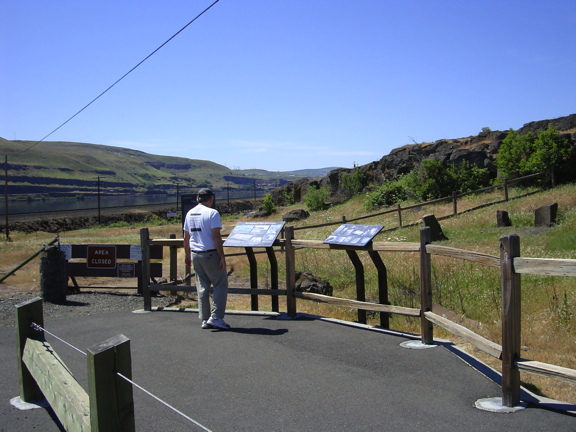
A number of petroglyphs and pictographs were actually "salvaged" by being physically removed from areas about to be submerged. Some of these rescued boulders, including a number of those shown in the old Benjamin Markham photos in this article, can be seen today along the Temani Peshwa Trail (photo below) at Columbia Hills State Park and at the Ginkgo Petrified Forest Recreation Area near Vantage, WA.

So let's take a look at the old photos! When available we've included both a historic picture (black and white) and a modern photo (color) so you can see how the rock art has changed in the last 75-100 years.
As the giant hydroelectric generation dams were built on the Columbia River beginning in the 1930's many Native American cultural areas, including rock art sites, were flooded by the large lakes that formed behind them. Photographers, professional and amateur, scrambled to record the ancient images before they disappeared.
By the way, if you have old photos of rock art from the Columbia Gorge and are willing to share them we would love to hear from you! Just send an email to culturewatch@gmail.com.
A number of petroglyphs and pictographs were actually "salvaged" by being physically removed from areas about to be submerged. Some of these rescued boulders, including a number of those shown in the old Benjamin Markham photos in this article, can be seen today along the Temani Peshwa Trail (photo below) at Columbia Hills State Park and at the Ginkgo Petrified Forest Recreation Area near Vantage, WA.
So let's take a look at the old photos! When available we've included both a historic picture (black and white) and a modern photo (color) so you can see how the rock art has changed in the last 75-100 years.
The photo on the left below was taken by Benjamin Markham in the 1920's. It shows the panel of petroglyphs in situ, still part of the cliff wall at Petroglyph Canyon. The same panel is visible at center left in the Willis Vail photo above. On the right below is the salvaged panel, now located on the Temani Peshwa Trail.


You will notice that the contrast between the petroglyphs and the background rock is much greater in the old photos. Historically it was a common practice to color or outline rock art with white chalk to make the images show up clearly in photos. This practice is now regarded as vandalism because it may take decades for the chalk to disappear.


You will notice that the contrast between the petroglyphs and the background rock is much greater in the old photos. Historically it was a common practice to color or outline rock art with white chalk to make the images show up clearly in photos. This practice is now regarded as vandalism because it may take decades for the chalk to disappear.

Images in situ at Petroglyph Canyon.
Markham Photo.
| ||
 
Images in situ at Petroglyph Canyon (at left above, Markham Photo circa 1920's) and as they looks today on the Temani Peshwa Trail at Columbia Hills State Park.

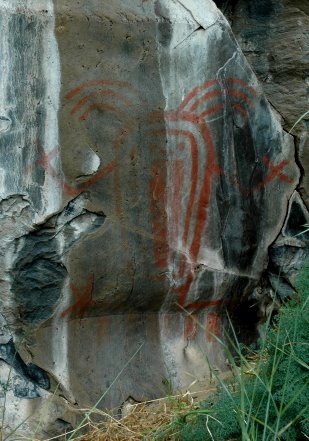
The photo on the left (attributed to Markham but unsigned) was taken near Wishram, WA. A modern photo shows the beautiful color of the images which are a combination of petroglyphs and pictographs (painted on the rock surface).

The two photos below were also taken by Markham
in the 1920's. Unfortunately we don't have any modern photos to compare them with. The image on the left was taken in Petroglyph Canyon and is now assumed to be submerged. The other was taken at a rock art site in Sherman County, Oregon.   Check out the historic photos at www.oldoregonphotos.com and when the weather warms up (after April 1) head out to Columbia Hills State Park where you can take a self-guided tour of the Tamani Peshwa Trail (whenever the park is open) and also a free guided tour of the other extensive rock art sites at the park (reservation required for the free tour, there is a small fee to enter the park). |

Friday, March 16, 2012
Good News From Lascaux!
 The latest issue of the International Newsletter on Rock Art (INORA 62-2012) arrived with the wonderful news that the creeping decay of the cave's stunning images is, for the most part, in remission!
This is great news after years of frustration in fighting the nasty micro-organisms that were attempting to literally "eat" the 19,000 year-old paintings.
All the images (click them to enlarge) in this post were taken by the French Ministry of Culture and Communication on June 1, 2011 and are used with permission (please do not copy or reproduce them). The photos and captions are as they were originally published in INORA.
Although access to the cave is severely limited I was privileged to enter the original Lascaux in July, 2001 and view the images displayed here. These recent examinations and photos are very reassuring in that they show little or no apparent change since I saw the paintings 11 years ago...of course 11 years is insignificant in the lifespan of these ancient paintings...but the paintings were under aggressive attack by fungi and bacteria at the time.

 French scientists, with advice from the international scientific community, have been fighting the degradation of the images since the 1960s. The cave, discovered in 1940 and opened to the public in 1947, was closed to the public in 1963 (an excellent reproduction, Lascaux II, is available and has been visited by millions of people). Scientists installed new ventilation systems, applied fungicides, antibiotics and even lime as they fought the algae, fungi, bacteria and molds that plagued the cave.
It appears that what finally stabilized the cave is a policy of non-intervention that has been in effect since 2008. The author of the INORA article, Pedro Lima, calls this a "natural remission" and it is supported by the current Lascaux Scientific Council. There is still some controversy about this approach but the images are being watched closely and any resurgence of problems would be quickly noted.
Via the internet you can view an excellent virtual tour of the cave by clicking Lascaux.
We offer a guarded congratulations to the scientists and the French government on this success in stabilizing Lascaux. With luck and continued vigilance we hope these unique paintings will be safe for another 19,000 years.
Referenced Article:
Lascaux: Back to Balance
by Pedro Lima
INORA No.62-2012, Pages 1-7
Thanks to Dr. Jean Clottes, Lascaux Curator Muriel Mauriac, and Dr. Jean-Michel Geneste for information and permissions used to create this post.
You can subscribe to INORA (3 issues/year, an excellent publication)
- In the U.S. send $25 payable to ARARA to:
Dona Gillette
ARARA
1147 Vaquero Way
Nipomo, CA 93444
-In France send a 20 Euro check payable to ARAPE to:
ARAPE
11, rue du Fourcat
09000 FOIX, France
-If you are elsewhere or do not have a French bank account send a postal money order for 20 Euros to:
ARAPE
11, rue du Fourcat
09000 FOIX, France
For more INORA subscription info please contact yanik.leguillou@online.fr
Sunday, November 6, 2011
New e-Book! "In the Footsteps of the Fremont...The Rock Art of Minnie's Gap, Wyoming"
CultureWatch Northwest is pleased to publish this free e-book for your education and enjoyment! We've used an on-line service called Shutterfly to produce the book and make it freely available on our website. You can read the full book by clicking below and you can purchase a printed copy from Shutterfly if you like (CultureWatch receives none of the proceeds).
The Minnie's Gap site was first scientifically surveyed and reported in 1962 by the University of Utah in conjunction with the construction of the Flaming Gorge Dam and Reservoir. In 2011, Archaeologist and Team leader Dr. James D. Keyser recognized two of the drawings in the report as important Fremont Culture (ca. AD 700-1200) symbolism and organized the project to professionally study them.
We hope you enjoy this look at the beautiful rock art of Minnie's Gap, Wyoming!
From the book...
Click here to view this photo book larger
"In June 2011 a team of archaeologists from the Oregon Archaeological Society and CultureWatch Northwest surveyed, photographed, and recorded the important ancient Indian rock art at the Minnie's Gap, Wyoming site.
The Minnie's Gap site was first scientifically surveyed and reported in 1962 by the University of Utah in conjunction with the construction of the Flaming Gorge Dam and Reservoir. In 2011, Archaeologist and Team leader Dr. James D. Keyser recognized two of the drawings in the report as important Fremont Culture (ca. AD 700-1200) symbolism and organized the project to professionally study them.
The team (below) sincerely appreciates the cooperation of landowners Pat and Pauleen Baker of Dutch John, Utah who allowed us to access the site and we dedicate this volume to them."
Michael Taylor, CultureWatch Northwest/Oregon Archaeological Society
Dr. James D. Keyser, Oregon Archaeological Society
George Poetschat, Oregon Archaeological Society
David Kaiser, Oregon Archaeological Society
Steve Rathman, Oregon Archaeological Society
Friday, September 2, 2011
People & Plants: Study of Ancient Oregon Rock Shelter Topic of September OAS Lecture
 |
| Catlow Valley Highway-Photo Courtesy of Dave Anderson (Picasa) |
The Oregon Archaeological Society will offer its first lecture of the year on Tuesday, September 6, 2011. The title of the lecture is “People and Plants: Paleobotanical Studies at a Late Archaic Rock Shelter in Oregon’s Catlow Valley.” Jaime Dexter, a doctoral student in Archaeology at the University of Oregon, is the featured speaker.
Dexter’s research interests include paleoethnobotany, palynology, plant genetics, and environmental archaeology. She has studied the subsistence strategies of hunter-gatherer populations in the northwestern Great Basin and is specifically interested in utilizing cross-disciplinary approaches to recognize and address prehistoric environmental impacts.
The presentation is at the Oregon Museum of Science and Industry (OMSI) at 7:45 PM, and is free and open to the public. The talk is preceded at 7 PM by a general business meeting, which is also open to the public
See www.oregonarchaeological.org or call 503-727-3507 for more information.www.oregonarchaeological.org.
OAS Field Trip: Huckleberry Processing Fields, Saturday, September 10 - Space Available!
Rick McClure, Forest Archaeologist & Heritage Program Manager for the Gifford Pinchot National Forest at Mt. Adams, Washington and archaeologist Cheryl Mack, will conduct two field trips to huckleberry processing field sites, focusing on the archaeology of the Cascade Crest - late summer upland use oriented toward collection and processing of huckleberries. The trip is expected to last the entire day.
 |
| Photo courtesy Fat of the Land |
Meet at 9:00 a. m. at the Mt. Adams Ranger Station. This trip will go into the Indian Heaven Wilderness and is more difficult due to hiking conditions.
Contact Betty Tandberg (360) 695-6021 or tandberg0408@comcast.net to sign up for either of these trips since the number of participants is limited.
Final Resting Place of Clark County Pioneers

Columbian Staff Reporter
It wasn’t easy for the dozen or so family members to pack up a wagon train in 1850 and bump, thump and roll their way from Missouri to what would eventually become east Vancouver.
When they staked their claims for free land around the Columbia River and Government Island, the small band probably didn’t consider that one day they’d end up as founding members of a county that would grow to more than 425,000 people...
Read the whole story at: Fishers Cemetery
British Columbia Village May Be 10,000 Years Old
Mark HumeWhen they staked their claims for free land around the Columbia River and Government Island, the small band probably didn’t consider that one day they’d end up as founding members of a county that would grow to more than 425,000 people...
Read the whole story at: Fishers Cemetery
British Columbia Village May Be 10,000 Years Old
Globe & Mail

But shortly after the team from the University of Northern British Columbia started to sink pits into a shell midden (refuse dump) on the Central Coast, he realized it was much bigger than anyone imagined – so large he now believes it is part of a long-lost, ancient village called Luxvbalis...
Read the whole story at: Ancient Village

When Farid Rahemtulla and his anthropology students began to dig in the forest floor on Calvert Island, he pretty much knew what to expect – lots of clam and mussel shells.
But shortly after the team from the University of Northern British Columbia started to sink pits into a shell midden (refuse dump) on the Central Coast, he realized it was much bigger than anyone imagined – so large he now believes it is part of a long-lost, ancient village called Luxvbalis...
Read the whole story at: Ancient Village
By Jeff German
Las Vegas Review-Journal


The desecration last year of prehistoric artwork at the Red Rock Canyon National Conservation Area sparked outrage and focused attention on the spread of graffiti throughout the Las Vegas Valley.
This week, the 17-year-old youth charged with defacing the Red Rock area received his punishment behind closed doors in federal court, ending a case that rallied the community to help remove the spray-painted graffiti...
This week, the 17-year-old youth charged with defacing the Red Rock area received his punishment behind closed doors in federal court, ending a case that rallied the community to help remove the spray-painted graffiti...
Read the whole sad story at: Rock Art Graffiti
By Brandon Keim
Wired
A fresh analysis of Ötzi the Iceman’s stomach suggests a grisly new climax to the world’s most famous prehistory murder mystery: death by ambush, a surprise killing in the afterglow of a big meal.
Ötzi was found in 1991, frozen and fantastically preserved in ice high in the Italian Alps, where he’d perished 5,300 years ago. With his tattoos and cool tools and smart outfit, rendered by artists with soulful brown eyes under a weathered brow, he became a Copper Age celebrity. Public and scientific imagination seized on the circumstances of his life — and, of course, his death...
A fresh analysis of Ötzi the Iceman’s stomach suggests a grisly new climax to the world’s most famous prehistory murder mystery: death by ambush, a surprise killing in the afterglow of a big meal.
Ötzi was found in 1991, frozen and fantastically preserved in ice high in the Italian Alps, where he’d perished 5,300 years ago. With his tattoos and cool tools and smart outfit, rendered by artists with soulful brown eyes under a weathered brow, he became a Copper Age celebrity. Public and scientific imagination seized on the circumstances of his life — and, of course, his death...
Otzi fans can read the whole story at: Otzi Dies on Full Stomach
By Ian Sample
Guardian.co.uk

A recent discovery suggests early humans were wielding sophisticated stone tools at least 300,000 years earlier than thought. A rare haul of picks, flakes and hand axes recovered from ancient sediments in Kenya are the oldest remains of advanced stone tools yet discovered.
Archaeologists unearthed the implements while excavating mudstone banks on the shores of Lake Turkana in the remote north-west of the country.
Archaeologists unearthed the implements while excavating mudstone banks on the shores of Lake Turkana in the remote north-west of the country.
Read the whole story at: Ancient Tools
(Thanks to Robin Harrower, Russel Micnhimer, The Columbian, Wired, the Guardian, The Globe and Mail, and Las Vegas Review-Journal for some of the info in this post.)
Monday, July 4, 2011
Rare Chinook House Stone Re-discovered!

Kloshe Nanitch
The Guardian of Altoona
In April Portland archaeologist Melissa Darby connected me to Kari Kandoll, the curator of the Wahkiakum County Historical Society Museum in Cathlamet, WA. Cathlamet is a small community about 65 miles west and down the Columbia River from Vancouver and Portland.
Kari and her staff had recently uncovered a small, interestingly carved boulder in the storage area of the museum. The boulder had been donated long ago by a local resident and since forgotten among the thousands of items in the museum's collection.
Late in June Kari brought the stone to the CultureWatch NW office in Vancouver where we took the photos included here.

The figure probably represents a mythological character important in the Chinookan spiritual belief structure. Such carved figures, in stone or wood, were erected outside longhouses to protect the occupants from evil spirits and influences.
Note the tapered lower end of the stone which would have been buried in the earth, securing the stone in an upright position near the front of the house.

Also notice the triangular ribbed carving on the back of the figure. In several other examples of Chinookan carving this shape represents the exaggerated tail of an animal (a beaver or mountain sheep) providing another indication that perhaps the human-like face on the front of the stone is not actually human, but a protective spirit figure.

Once we had identified what the carved stone was we wanted to come up with a suitable name that would recognize its significance and honor its purpose. After consulting a Chinook Jargon Phrasebook I suggested the name "Kloshe Nanitch", The Guardian of Altoona.
The words mean "take care, stand guard, watch out"...suitable terms for a house stone that would have protected occupants of a long house hundreds of years ago.
Now Kloshe Nanitch is headed for a place of honor on display in the Wahkiakum Museum near where it served its original purpose guarding the Chinook people of Altoona.
VISIT KLOSHE NANITCH & CATHLAMET!
Historic Cathlamet is an easy day trip from Portland or Vancouver and is well worth visiting. While you're there you can stop in at the Historical Society Museum, check out Kloshe Nanitch and enjoy an extensive exhibit and photo collection, including logging, fishing, maritime, farming, families, towns, and genealogy records.

65 River Street, Cathlamet, WA
360-795-3954 or 360-849-4353
360-795-3954 or 360-849-4353
Open: Open Saturday and Sunday from 1-4 the first full weekend in May and close the last weekend in October. Admission is $5 for adults, $3 for senior citizens and kids under 18 are free.
If you visit the weekend of July 16, Cathlamet will be holding its Bald Eagle Days festival, a traditional small town event with fun for everyone!

Wednesday, June 8, 2011
CultureWatch Director to Speak This Saturday

Columbia River Plateau archaeology and Indian rock art will be subjects of a talk and slide show Saturday at the quarterly meeting of the Camas-Washougal Historical Society.
Michael W. Taylor, a Washington native and co-author of five books, will speak about cultural resources, rock art and Columbia Plateau archaeology.
His presentation will be titled "Reconnecting with Nichi-Wana: Ancient Indian Rock Art of the Lower Columbia River".
Taylor has contributed to five books and numerous professional articles and presentations. He is the principal of Culture Watch Northwest, an organization dedicated to protecting “places that matter.” He has served as both president and director of the Oregon Archaeological Society.
Taylor’s talk is set for 2 p.m. Saturday in the community room of the Camas Police Station, 2100 N.E. Third Ave. There will be time for discussion and questions after his presentation. Learn more about Culture Watch Northwest at http://culturewatchnorthwest.blogspot.com.
Information courtesy of The Columbian. Read the original article at: Historical Society Hosts Archaeology TalkWednesday, May 18, 2011
Sacred Cave/Rock Art Vandalized Near Bend, OR
 Vandalism Discovered at Arnold Cave Complex in Central Oregon-Reward Offered
 April 21, 2011, during a visit to the Arnold cave complex, Forest Archaeologist Penni Borghi, Wildlife Specialist Julie York, local Grotto president Matt Skeels, and ASCO members Lisa Nicol and Susan Gray discovered extensive paint vandalism at Hidden Forest Cave.
Several different colors of spray paint graffiti covered a large stretch of the east face of the sink area, stopping just short of the drip line. Pictures do not do the damage justice (see video below)!
This cave is one of the most beautiful in the extensive lava tube systems in Central Oregon, and one of the most overused and badly treated. Past ASCO stewardship visits have reported evidence of vehicular traffic on the closed roads, illegal fire pits, damaged trees cut for firewood and shot up for whatever reason, large numbers of beer cans and bottles (many shattered against the rock faces), discarded clothing, and other types of graffiti.
If you are unsure about what activities are not permitted in the caves, you may read the Forest Service’s guidelines for cave access on their website. (http://www.fs.fed.us/r6/centraloregon/conditio ns/cave_access_deschutes.pdf)
If you have any information that could help the investigation into the vandalism at this site, please contact Eddy Cartaya, the Forest Service law enforcement officer handling the case, at the Bend-Fort Rock Office (541-383- 4796).
(Article above reprinted with permission from the ASCO May-June 2011 Midden. Thanks to Susan Gray, Editor of the Midden for sending us this info.)
VIDEO BELOW PROVIDED BY OREGON HIGH DESERT GROTTO
(caution...if you love rock art and/or caves this is a very disturbing video).
REWARD OFFERED/DONATE TO REWARD FUND
Oregon High Desert Grotto, a caving club based in Bend, OR, is offering a reward for information on the Hidden Forest Cave vandalism. They are also asking for donations to increase the reward fund. Click here for more info on the reward or to make a donationSunday, April 3, 2011
Warrior Art, Painted Caves, Flint-knapping, Mammoths ...and More
 OAS MEETING: TUESDAY, APRIL 5, 7:00 PM AT OMSI
“Recounting Days of Glory: Plains Indian Warrior Art” is the topic of the April 5, 2011 Oregon Archaeological Society lecture. Dr. James Keyser is the featured speaker.
Keyser has conducted rock art research across western North America including projects in Alberta, South Dakota, Montana, Wyoming, Colorado, Utah, Oregon, Washington, and Alaska. He also has an ongoing research interest in European rock art in France, Spain, and Italy. He is a member of the Science Advisory Committee for the Study of Chauvet Cave (France), and is listed in Who's Who in Rock Art. Prior to retirement, he served for 27 years as a regional archaeologist for the U.S. Forest Service. He maintains faculty affiliation with the University of Montana and has more than 150 archaeology publications of which more than 100 concern rock art, robe art, or ledger art.
The presentation is at Oregon Museum of Science and Industry (OMSI) at 7:45 PM, and is free and open to the public. The talk is preceded at 7 PM by a general business meeting, which is also open to the public
See www.oregonarchaeological.org or call 503-727-3507 for more information.
JEAN AUEL BOOKSIGNING AT THE OAS MAY MEETING

As you've probably heard by now Jean Auel has released a new book "The Land of Painted Caves"! Jean has tentatively agreed to come to the May OAS meeting to sign copies of her new book (if she's back from her intergalactic book launch tour).
OAS will have a few copies of the new book that you can buy at the meeting or you can bring your own.
We'll make another announcement later in April to confirm (or reschedule) the booksigning.
Read a great Oregonian article about Jean Auel at: "Where I Write: Jean M. Auel..."
OAS PRESIDENT DEMONSTRATES FLINT-KNAPPING AT FORT VANCOUVER

Dennis Torresdal, OAS President, was featured in a recent Columbian article titled "Flint-Knapping Fun". Dennis, an expert flint-knapper, created fine blades, projectile points...and a lot of debitage during a well-attended exhibition at the Fort.
Read all about it at: Fort Vancouver Flint-knapping
WENAS CREEK MAMMOTH EXCAVATIONS: LECTURE APRIL 11

Monday, April 11, 6:30 PM, Columbia Gorge Interpretive Center, 990 SW Rock Creek Dr., Stevenson, WA, Patrick Lubinski, Wenes Creek Mammoth.
Lecturer: Patrick Lubinski, Professor of Anthropology, Central Washington University.
The 2005 accidental discovery of a mammoth bone near Selah, Washington led to a six- year investigation by Central Washington University, providing a glimpse into life during that time. In addition to 16,000-year-old mammoth and bison bones, students and faculty have found human-made artifacts of unknown age that could shed new light on the early presence of people in Washington. Lubinski will summarize the project and its findings using bone casts, PowerPoint images and video. .
http://www.humanities.org/programs/speakers/current-speakers/inquiring-mind-speaker-patrick-lubinski
As this is an evening event the Interpretive Center will be closed. After you turn north on Rock Creek Drive from Washington SR14 look for the employees entrance/parking lot on your right (less than 1/2mile). If you get to Skamania Lodge Road or the main entrance to the Interpretive Center you have gone too far.
For more info: Patrick Lubinski
CENTER FOR JAPANESE STUDIES HOSTS PSU TALK MAY 19
May 19, 6PM PSU Smith Memorial Hall 238 presentation by DR. Ho Tae JEon (Harvard University) "Koguryo tomb murals and Japan in Ancient East Asian Funeral Arts" sponsored by the Portland State Center for Japanese Studies.
$10,000 FINE LEVIED..."NO, IT'S NOT COOL TO DEFACE NATIVE ROCK ART

Read more: Rock Art Fine
Tuesday, March 29, 2011
Arrival of the Earliest Americans: New Discoveries
 Clovis first?...Clovis second?...or maybe not Clovis at all?
Research and discoveries that directly impact our thinking on when the Americas were first populated is accelerating.
News from Oregon (that's Paisley Cave to the left), Texas, Mexico and elsewhere is pushing back the earliest dates and expanding the routes of first peopling.
My personal opinion is that we're only at the beginning of understanding how and when the first people arrived in North and South America.
I've been around science long enough to have learned that, whatever the topic, the popular scientific theories of the day usually turn out to be too simplistic to explain reality. The world is a complex and messy place that often can't be reduced to a single neat answer...but that's OK! Its the process of advancing theories and facts that push our understanding forward.
So it appears that the original theories of a single land bridge migration into North America aren't the whole answer. Check out the interesting videos and articles on the topic below...and see what you think!
Migrating to North America
 Here's a fascinating video about Paisley Cave, Oregon and the discoveries there. Click on the image to the left or on the link below to watch...
Click here for Paisley Cave video
Professor Dennis Jenkins (pictured below), who leads the project at Paisley Cave where evidence of human occupation as much as 14,000 years ago has been discovered, has prepared a fascinating overview that you can read by clicking here.


Researchers at Paisley Cave wear body suits to
eliminate potential contamination of DNA samples.
Skull in Underwater Cave May Be Earliest Trace of First Americans
National Geographic
February 18, 2011
By Fabio Esteban Amador
 Explorers have discovered what might be the oldest evidence of humans in the Americas. Alex Alvarez, Franco Attolini, and Alberto (Beto) Nava are members of PET (Projecto Espeleológico de Tulum), an organization that specializes in the exploration and survey of underwater caves on the Yucatan Peninsula in Mexico. Alex, Franco and Beto have surveyed tens of thousands of feet of mazelike cave passages in the state of Quintana Roo. The team’s relatively recent explorations of a large pit named Hoyo Negro (Black Hole, in Spanish), deep within a flooded cave, resulted in their breathtaking and once-in-a-lifetime discovery of the remains of an Ice Age mastodon and a human skull at the very bottom of the black abyss...
Read the whole story by clicking on the photo or here.
 Spear Points Found in Texas Dial Back Arrival of Humans in America
By John Noble Wilford
New York Times Science
Published: March 24, 2011
For many years, scientists have thought that the first Americans came here from Asia 13,000 years ago, during the last ice age, probably by way of the Bering Strait. They were known as the Clovis people, after the town in New Mexico where their finely wrought spear points were first discovered in 1929.
But in more recent years, archaeologists have found more and more traces of even earlier people with a less refined technology inhabiting North America and spreading as far south as Chile.
And now clinching evidence in the mystery of the early peopling of America — Clovis or pre-Clovis? — for nearly all scientists appears to have turned up at a creek valley in the hill country of what is today Central Texas, 40 miles northwest of Austin...
Read the whole story by clicking the photo above or here.
Thanks to Russel Micnhimer, Robin Harrower, the New York Times, University of Oregon, and National Geographic for contributing some of the info used in this post.
Sunday, February 27, 2011
Huckleberries, New Auel Book, Chauvet Film...and more!
OAS MEETING THIS TUESDAY, MARCH 1, 7:00 PM AT OMSI
 “From the Mountains Beyond: The Archaeology of Huckleberry and Cedar in the Southern Washington Cascades” is the title of the March 1, 2011 lecture sponsored by the Oregon Archaeological Society. Rick McClure, the Forest Archaeologist and Heritage Program Manager for Gifford Pinchot National Forest, will discuss the record left by Lewis and Clark regarding the many resources—including plant foods--they encountered and their cultural significance to local Native peoples.
Some of these resources were from the surrounding uplands - the mountains beyond - areas managed today as national forest system lands. The presentation will take a closer look at several specific resources, beginning with descriptions from the pages of the expedition journals, and moving to the archaeology of the mountains beyond, to investigate traditional land use practices in the period 1805-1806.
The presentation is at Oregon Museum of Science and Industry (OMSI) at 7:45 PM, and is free and open to the public. The talk is preceded at 7 PM by a general business meeting, which is also open to the public See www.oregonarchaeological.org or call 503-727-3507 for more information.
CLARK COUNTY MUSEUM HONORS OAS MEMBER RICHARD REAY

The Clark County Historical Museum threw a party on Jan. 19 for Richard Reay, who has volunteered there for a decade. He didn’t want any fuss, so the museum made it a surprise party. “Richard made himself indispensable to staff, other volunteers and visitors alike with his can-do attitude, endless patience, attention to detail, and encyclopedic knowledge of our reference library as well as the last 10 years of museum history,” a museum press release stated. “In a word, Richard is irreplaceable.”
Read more at: Richard Reay Honored
JEAN M. AUEL'S NEW BOOK TO BE RELEASED MARCH 29, 2011!
The highly anticipated sixth book of Jean Auel’s Earth’s Children® series, The Land of Painted Caves, is the culmination fans have been waiting for. Continuing the story of Ayla and Jondalar, Auel combines her brilliant narrative skills and appealing characters with a remarkable re-creation of the way life was lived more than 25,000 years ago.
See more about the book and read free chapters at:
The Land of Painted Caves
See Jean Auel talk about her new book on video: Painted Caves Interview
And here's a "trailer" for the book...
CHAUVET CAVE FILM TO BE RELEASED!
Werner Herzog's new film "Cave of Forgotten Dreams" is a stunning 3D documentary about the cave in France that is home to the world's oldest known human art. The film, which includes appearances by Dr. Jean Clottes, is scheduled to be released in March.
So far no schedule for showings has been released, but stay tuned!
Read more at: Herzog Chauvet Interview
More about the film: Herzog website
...and here's the official movie trailer...
OREGON TRAIL/ANTELOPE RIDGE WIND FARM UPDATE
Over the past week I learned that Portland-based Archaeological Investigations Northwest Inc. (AINW) is the firm doing the archaeological research and analysis on the wind project. This is encouraging because AINW is a very good and highly respected firm...but keep in mind that AINW (like any archaeological consulting organization) is only in a position to analyze and recommend things to the various regulatory agencies that have the real decision-making power that will determine the fate of the Oregon Trail in the project area.
According to Terry Ozbun, Senior Archaeologist at AINW...
"AINW is conducting cultural resource surveys for the Antelope Ridge Wind Energy Project to provide information for appropriate protections of historic and archaeological resources during the project planning process. For over a year now, the project developer has been working closely with the Oregon-California Trails Association (OCTA) and with the Oregon Historic Trails Advisory Council (OHTAC) to formulate plans for avoiding impacts to the Oregon Trail. This collaboration was proactively initiated by the developer and has been productive and sincere. All of the parties are working very hard to find a way to develop wind energy and, at the same time, protect the Oregon Trail, along with other important cultural resources.
The project's permit application is available online at http://www.horizonwindfarms.com/western-region/under-dev/antelope-ridge.htm and I would also be happy to field questions that OAS members may have about the project." You can reach Terry at: terry@ainw.com.
I encourage you to let your elected officials and representatives of the regulatory agencies (see my previous email for details) know how you feel about protecting the Oregon Trail for future generations.
ENDANGERED PLACES LIST STARTED BY LEAGUE
The Historic Preservation League of Oregon is creating a most endangered places list for Oregon. The list will be an annual register of those historic buildings, and sites, and districts, and structures, and landscapes that need a little extra attention in order to make it to the next phase.
You can submit a nomination until March 21. While a diversity of places will be selected, historic significance, the nature of the threat, and the potential for local support will be considered during review process. The inaugural list will be announced in late May, after which the league will actively support the selected places through partnerships and direct assistance.
For more information and a nomination form, visit www.historicpreservationleague.org
That's all for now. Let me know if you like the new eNews format (mike@instantiations.com).
 “From the Mountains Beyond: The Archaeology of Huckleberry and Cedar in the Southern Washington Cascades” is the title of the March 1, 2011 lecture sponsored by the Oregon Archaeological Society. Rick McClure, the Forest Archaeologist and Heritage Program Manager for Gifford Pinchot National Forest, will discuss the record left by Lewis and Clark regarding the many resources—including plant foods--they encountered and their cultural significance to local Native peoples.
Some of these resources were from the surrounding uplands - the mountains beyond - areas managed today as national forest system lands. The presentation will take a closer look at several specific resources, beginning with descriptions from the pages of the expedition journals, and moving to the archaeology of the mountains beyond, to investigate traditional land use practices in the period 1805-1806.
The presentation is at Oregon Museum of Science and Industry (OMSI) at 7:45 PM, and is free and open to the public. The talk is preceded at 7 PM by a general business meeting, which is also open to the public See www.oregonarchaeological.org or call 503-727-3507 for more information.
CLARK COUNTY MUSEUM HONORS OAS MEMBER RICHARD REAY

The Clark County Historical Museum threw a party on Jan. 19 for Richard Reay, who has volunteered there for a decade. He didn’t want any fuss, so the museum made it a surprise party. “Richard made himself indispensable to staff, other volunteers and visitors alike with his can-do attitude, endless patience, attention to detail, and encyclopedic knowledge of our reference library as well as the last 10 years of museum history,” a museum press release stated. “In a word, Richard is irreplaceable.”
Read more at: Richard Reay Honored
JEAN M. AUEL'S NEW BOOK TO BE RELEASED MARCH 29, 2011!
The highly anticipated sixth book of Jean Auel’s Earth’s Children® series, The Land of Painted Caves, is the culmination fans have been waiting for. Continuing the story of Ayla and Jondalar, Auel combines her brilliant narrative skills and appealing characters with a remarkable re-creation of the way life was lived more than 25,000 years ago.See more about the book and read free chapters at:
The Land of Painted Caves
See Jean Auel talk about her new book on video: Painted Caves Interview
And here's a "trailer" for the book...
CHAUVET CAVE FILM TO BE RELEASED!
Werner Herzog's new film "Cave of Forgotten Dreams" is a stunning 3D documentary about the cave in France that is home to the world's oldest known human art. The film, which includes appearances by Dr. Jean Clottes, is scheduled to be released in March.
So far no schedule for showings has been released, but stay tuned!
Read more at: Herzog Chauvet Interview
More about the film: Herzog website
...and here's the official movie trailer...
OREGON TRAIL/ANTELOPE RIDGE WIND FARM UPDATE
Over the past week I learned that Portland-based Archaeological Investigations Northwest Inc. (AINW) is the firm doing the archaeological research and analysis on the wind project. This is encouraging because AINW is a very good and highly respected firm...but keep in mind that AINW (like any archaeological consulting organization) is only in a position to analyze and recommend things to the various regulatory agencies that have the real decision-making power that will determine the fate of the Oregon Trail in the project area.
According to Terry Ozbun, Senior Archaeologist at AINW...
"AINW is conducting cultural resource surveys for the Antelope Ridge Wind Energy Project to provide information for appropriate protections of historic and archaeological resources during the project planning process. For over a year now, the project developer has been working closely with the Oregon-California Trails Association (OCTA) and with the Oregon Historic Trails Advisory Council (OHTAC) to formulate plans for avoiding impacts to the Oregon Trail. This collaboration was proactively initiated by the developer and has been productive and sincere. All of the parties are working very hard to find a way to develop wind energy and, at the same time, protect the Oregon Trail, along with other important cultural resources.
The project's permit application is available online at http://www.horizonwindfarms.com/western-region/under-dev/antelope-ridge.htm and I would also be happy to field questions that OAS members may have about the project." You can reach Terry at: terry@ainw.com.
I encourage you to let your elected officials and representatives of the regulatory agencies (see my previous email for details) know how you feel about protecting the Oregon Trail for future generations.
ENDANGERED PLACES LIST STARTED BY LEAGUE
The Historic Preservation League of Oregon is creating a most endangered places list for Oregon. The list will be an annual register of those historic buildings, and sites, and districts, and structures, and landscapes that need a little extra attention in order to make it to the next phase.
You can submit a nomination until March 21. While a diversity of places will be selected, historic significance, the nature of the threat, and the potential for local support will be considered during review process. The inaugural list will be announced in late May, after which the league will actively support the selected places through partnerships and direct assistance.
For more information and a nomination form, visit www.historicpreservationleague.org
That's all for now. Let me know if you like the new eNews format (mike@instantiations.com).
Tuesday, December 28, 2010
Archaeology Presentations, Rock Art Guide, Old Teeth, & A Third Branch of Humanity
 OAS MEETING - TUESDAY, JAN. 4, 2011 - Revisiting the Meier Site
Dr. Kenneth Ames is the featured speaker at the January 4, 2011 Oregon Archaeological Society meeting. He will be talking about the Meier Site and Lower Columbia River archaeology.
The Meier Site, located near Scappoose, Oregon, is one of the most significant sites on the Lower Columbia River. It was excavated between 1987 and 1991. The site dates to the period from about AD 1400 to at least through the founding of Ft. Vancouver, in the 1830s and beyond. The Meier site revealed major residential habitation with a massive plankhouse. The talk reviews the results of analyses of thousands of artifacts, focusing on the Meier site, while also discussing other sites along the river.
Dr. Ames is Professor and Department Chair of Anthropology at Portland State University. He has conducted numerous archaeological field research in western North America and has authored numerous publications and reports.
The lecture will be held in the OMSI auditorium at 7:45 PM, and is free and open to the public. The presentation is preceded at 7 PM by a general business meeting, which is also open to the public. See www.oregonarchaeological.org or call 503-727-3507 for information.
ARCHAEOLOGY FOR THE CURIOUS-OAS BASIC TRAINING STILL AVAILABLE!
Are you looking to learn more about archaeology basics, or do you need a refresher on the history of the Pacific Northwest? The Oregon Archaeological Society offers an annual Training program.
OAS Basic Training, also known as Archaeology for the Curious, is taught by experienced regional professionals from organizations such as the National Forest Service, BLM, and the University of Oregon. The sessions will be held on six Saturdays in late Winter/early Spring.
Contact Steve Satterthwaite (503) 824-2264 satterts@hotmail.com or visit http://www.oregonarchaeological.org/training.htm
NEW ROCK ART GUIDE BOOK NOW AVAILABLE
 Oregon avocational archaeologists D. Russel Micnhimer and LeeAnn Johnston announce the publication of their new guide book, Where to See Rock Art: Washington Oregon Idaho by Pendulum Press.
It contains general information about various aspects of rock art and specific information about where rock art can be seen in museums, visitor centers, state parks and public lands in Washington, Oregon and Idaho. Photographs, line drawings and a brief description give readers an idea of what they will find at 39 locations in the three states. The table of contents make it easy to access the information in this 147 page paperback.
The authors are members of the Oregon Archaeological Society and have received numerous Loring & Loring Grants from the organization in support of their on going research and website www.oregonrockart.com.
The new book is available directly from Russel Micnhimer, P. O. Box 1653, Prineville, OR 97754. $14.95 + $4.00 S&H (USPS). For more information email TalkingEarth@hotmail.com.
(I've read Russel and LeeAnn's new book and its a great guide for anyone who wants to visit the very interesting public rock art sites of the Pacific Northwest...Mike)
DOUGLAS HISTORIAN TO SPEAK IN PORTLAND, VANCOUVER
Author Jack Nisbet will talk about "Point of Departure: David Douglas at Fort Vancouver 1825-33" at 2 p.m. Jan. 9 at E.B. Hamilton Hall on the Fort Vancouver National Site. Nisbet will also give a reading from his book "The Collector: David Douglas and the Natural History of the Northwest" at 7:30 p.m. Jan. 10 at Powell's bookstore in downtown Portland.
Douglas was the premier botanical explorer in the Pacific Northwest and western North America in the 19th century. His base of operations always remained at Fort Vancouver. The people he met there influenced his every move, and the changes he witnessed during his visits mark significant turning points for the social, economic, scientific, and environmental stories of the region. In this illustrated presentation at Fort Vancouver, Nisbet traces the energy Douglas brought to, and absorbed from, his central headquarters at Fort Vancouver. Nisbet is this year's Michael M. Powell Fellow at the Center for Columbia River History.
For program information, go to http://www.ccrh.org/calendar.php
AN OLDER ORIGIN FOR 'MODERN' TOOL-MAKING TECHNIQUE?
By News Services-October 29, 2010
 A technique for shaping stones into sharp-edged points may have emerged about 55,000 years earlier than previously known, according to a study of stone tools from Blombos Cave in South Africa. Previously, researchers have also found other evidence of “modern” human behavior, such as shell beads, from this 75,000-year-old site, where new ideas and techniques may have been rapidly introduced...
Read the whole story at: http://www.flickeringtorches.com/2010/10/29/an-older-origin-for-modern-tool-making-technique.html
HUMAN, NEANDERTHAL, OR OTHER?
Finger Bones Point to New Branch of Humanity
By Charles Q. Choi
Published December 22, 2010
LiveScience
 A finger bone and other remains from Siberia now reveals a previously unknown group of ancient humans once existed there, one neither like us nor Neanderthals.
Bizarrely, the DNA from these extinct Siberians seems unusually similar to that of Pacific Islanders from tropical Melanesia.The 30,000-year-old fossil was found in Denisova Cave in southern Siberia in 2008, a bone fragment that likely came from a fingertip of a young girl. It was discovered along with microblades (small stone blades used as tools), body ornaments of polished stone, and a molar shaped very differently from that of Neanderthals and modern humans, resembling that of much older human species, such as Homo habilis and Homo erectus. (The tooth and the finger bone apparently came from different members of the same population.)...
Read more: New Branch of Humanity?
More at: Three Types of Ancient Humans?
RESEARCHERS: ANCIENT HUMAN REMAINS FOUND IN ISRAEL
By Daniel Estrin
Associated Press – Mon Dec 27
 JERUSALEM –Israeli archaeologists said Monday they may have found the earliest evidence yet for the existence of modern man, and if so, it could upset theories of the origin of humans. A Tel Aviv University team excavating a cave in central Israel said teeth found in the cave are about 400,000 years old and resemble those of other remains of modern man, known scientifically as Homo sapiens, found in Israel. The earliest Homo sapiens remains found until now are half as old...
Read the whole story at: Ancient Teeth
ANCIENT ROCK ART'S COLOURS COME FROM MICROBES
BBC Mobile
December 27, 2010

A particular type of ancient rock art in Western Australia maintains its vivid colours because it is alive, researchers have found...
Read more at: http://goo.gl/eAEFH
(Thanks to Oregon Heritage News, News Services, LiveScience, the Associated Press, Russel Micnhimer, and Jodi Lorimer for some of the info in this message).
Subscribe to:
Posts (Atom)