Current topics in archaeology, cultural heritage & historic preservation

Showing posts with label Columbia Gorge. Show all posts

Tuesday, January 1, 2013

Petroglyph Canyon Historic Photos

Large wall of rock art at Petroglyph Canyon (Willis Vail Photo, 1905. © Old Oregon Photos.) 


For thousands of years native people carved and painted spiritually important images on the basalt cliff faces of what came to be known as Petroglyph Canyon. The canyon is located in south central Washington state near Columbia Hills State Park (see image below).


View of Petroglyph Canyon location. Columbia Hills State Park is at the red "You Are Here" dot (image courtesy of Washington State Parks)

Petroglyph Canyon was reported to have one of the largest concentrations of Indian rock art in North America before it was largely submerged in the pool behind The Dalles Dam (photo below) in 1957. Today much of the rock art, and the canyon itself, lie hidden beneath the waters of Horsethief Lake and the Columbia River at Columbia Hills State Park near Dallesport, WA.

We recently came across a website (www.oldoregonphotos.com) that displays (and sells) historic photographs.  John Klatt, who owns the Old Oregon website, has graciously allowed CultureWatch NW to reproduce some very old photos of Columbia Gorge rock art. (All historic photos in this post are © Old Oregon Photos).

As the giant hydroelectric generation dams were built on the Columbia River beginning in the 1930's many Native American cultural areas, including rock art sites, were flooded by the large lakes that formed behind them. Photographers, professional and amateur, scrambled to record the ancient images before they disappeared. 

By the way, if you have old photos of rock art from the Columbia Gorge and are willing to share them we would love to hear from you! Just send an email to culturewatch@gmail.com.

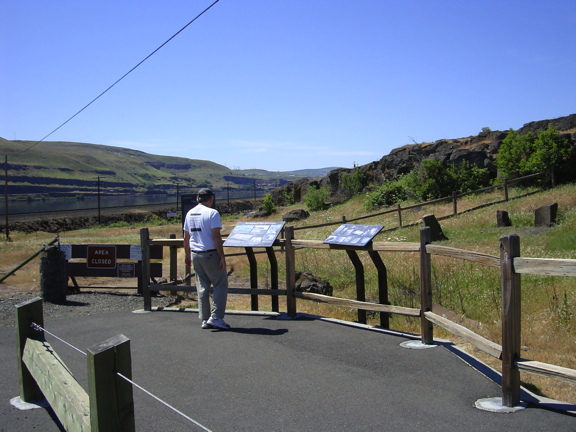
A number of petroglyphs and pictographs were actually "salvaged" by being physically removed from areas about to be submerged. Some of these rescued boulders, including a number of those shown in the old Benjamin Markham photos in this article, can be seen today along the Temani Peshwa Trail (photo below) at Columbia Hills State Park and at the Ginkgo Petrified Forest Recreation Area near Vantage, WA.

So let's take a look at the old photos! When available we've included both a historic picture (black and white) and a modern photo (color) so you can see how the rock art has changed in the last 75-100 years.

The photo on the left below was taken by Benjamin Markham in the 1920's. It shows the panel of petroglyphs in situ, still part of the cliff wall at Petroglyph Canyon. The same panel is visible at center left in the Willis Vail photo above. On the right below is the salvaged panel, now located on the Temani Peshwa Trail.


You will notice that the contrast between the petroglyphs and the background rock is much greater in the old photos. Historically it was a common practice to color or outline rock art with white chalk to make the images show up clearly in photos. This practice is now regarded as vandalism because it may take decades for the chalk to disappear.


Images in situ at Petroglyph Canyon. 
Markham Photo.

Salvaged boulder as it sits today on the Temni Peshwa Trail.

          
       Images in situ at Petroglyph Canyon (at left above, Markham Photo circa 1920's) and as they looks today on the Temani Peshwa Trail at Columbia Hills State Park.


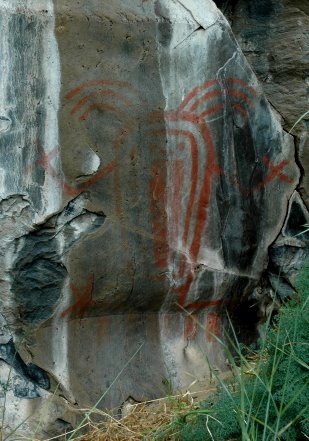
The photo on the left (attributed to Markham but unsigned) was taken near Wishram, WA. A modern photo shows the beautiful color of the images which are a combination of petroglyphs and pictographs (painted on the rock surface).


The two photos below were also taken by Markham 
in the 1920's. Unfortunately we don't have any modern 
photos to compare them with. The image on the left was taken 
in Petroglyph Canyon and is now assumed to be 
submerged. The other was taken at a rock art site in 
Sherman County, Oregon.


Check out the historic photos at www.oldoregonphotos.com and when the weather warms up (after April 1) head out to Columbia Hills State Park where you can take a self-guided tour of the Tamani Peshwa Trail (whenever the park is open) and also a free guided tour of the other extensive rock art sites at the park (reservation required for the free tour, there is a small fee to enter the park).
         

Friday, September 2, 2011

People & Plants: Study of Ancient Oregon Rock Shelter Topic of September OAS Lecture

Catlow Valley Highway-Photo Courtesy of Dave Anderson (Picasa)
OAS Meeting & Presentation: Tuesday, September 6
The Oregon Archaeological Society will offer its first lecture of the year on Tuesday, September 6, 2011. The title of the lecture is “People and Plants: Paleobotanical Studies at a Late Archaic Rock Shelter in Oregon’s Catlow Valley.” Jaime Dexter, a doctoral student in Archaeology at the University of Oregon, is the featured speaker.


Dexter’s research interests include paleoethnobotany, palynology, plant genetics, and environmental archaeology. She has studied the subsistence strategies of hunter-gatherer populations in the northwestern Great Basin and is specifically interested in utilizing cross-disciplinary approaches to recognize and address prehistoric environmental impacts.


The presentation is at the Oregon Museum of Science and Industry (OMSI) at 7:45 PM, and is free and open to the public. The talk is preceded at 7 PM by a general business meeting, which is also open to the public


See www.oregonarchaeological.org or call 503-727-3507 for more information.www.oregonarchaeological.org.

OAS Field Trip: Huckleberry Processing Fields, Saturday, September 10 - Space Available!
Photo courtesy Fat of the Land
Rick McClure, Forest Archaeologist & Heritage Program Manager for the Gifford Pinchot National Forest at Mt. Adams, Washington and archaeologist Cheryl Mack, will conduct two field trips to huckleberry processing field sites, focusing on the archaeology of the Cascade Crest - late summer upland use oriented toward collection and processing of huckleberries. The trip is expected to last the entire day. 


Meet at 9:00 a. m. at the Mt. Adams Ranger Station. This trip will go into the Indian Heaven Wilderness and is more difficult due to hiking conditions.


Contact Betty Tandberg (360) 695-6021 or tandberg0408@comcast.net to sign up for either of these trips since the number of participants is limited.

Final Resting Place of Clark County Pioneers
By Sue Vorenberg
Columbian Staff Reporter

It wasn’t easy for the dozen or so family members to pack up a wagon train in 1850 and bump, thump and roll their way from Missouri to what would eventually become east Vancouver.


When they staked their claims for free land around the Columbia River and Government Island, the small band probably didn’t consider that one day they’d end up as founding members of a county that would grow to more than 425,000 people...


Read the whole story at: Fishers Cemetery


British Columbia Village May Be 10,000 Years Old
Mark Hume
Globe & Mail
When Farid Rahemtulla and his anthropology students began to dig in the forest floor on Calvert Island, he pretty much knew what to expect – lots of clam and mussel shells.


But shortly after the team from the University of Northern British Columbia started to sink pits into a shell midden (refuse dump) on the Central Coast, he realized it was much bigger than anyone imagined – so large he now believes it is part of a long-lost, ancient village called Luxvbalis...

Read the whole story at: Ancient Village

Teen Gets Prison in Red Rock Graffiti Case
By Jeff German
Las Vegas Review-Journal
The desecration last year of prehistoric artwork at the Red Rock Canyon National Conservation Area sparked outrage and focused attention on the spread of graffiti throughout the Las Vegas Valley.


This week, the 17-year-old youth charged with defacing the Red Rock area received his punishment behind closed doors in federal court, ending a case that rallied the community to help remove the spray-painted graffiti...

Read the whole sad story at: Rock Art Graffiti

Ötzi the Iceman Murdered on a Full Stomach
By Brandon Keim
Wired
A fresh analysis of Ötzi the Iceman’s stomach suggests a grisly new climax to the world’s most famous prehistory murder mystery: death by ambush, a surprise killing in the afterglow of a big meal.


Ötzi was found in 1991, frozen and fantastically preserved in ice high in the Italian Alps, where he’d perished 5,300 years ago. With his tattoos and cool tools and smart outfit, rendered by artists with soulful brown eyes under a weathered brow, he became a Copper Age celebrity. Public and scientific imagination seized on the circumstances of his life — and, of course, his death...

Otzi fans can read the whole story at: Otzi Dies on Full Stomach

Hand Axes Unearthed in Kenya are Oldest Advanced Stone Tools Ever Found
By Ian Sample
Guardian.co.uk
A recent discovery suggests early humans were wielding sophisticated stone tools at least 300,000 years earlier than thought. A rare haul of picks, flakes and hand axes recovered from ancient sediments in Kenya are the oldest remains of advanced stone tools yet discovered.


Archaeologists unearthed the implements while excavating mudstone banks on the shores of Lake Turkana in the remote north-west of the country.

Read the whole story at: Ancient Tools

(Thanks to Robin Harrower, Russel Micnhimer, The Columbian, Wired, the Guardian, The Globe and Mail, and Las Vegas Review-Journal for some of the info in this post.)

Sunday, December 12, 2010

The Petroglyph Rubbings at Skamania Lodge


I was lucky enough to get to attend a Christmas party at Skamania Lodge in Stevenson, WA this weekend.

Very nice place and they have an excellent collection of petroglyph rubbings and Pacific coast Indian-inspired wood carving displayed throughout the hotel.

The rubbings are mostly of ancient images found on the Columbia River Plateau. The region is home to hundreds of petroglyphs that have been carved into the surface of the native basalt and also to many pictographs that are painted on the rock.

Some of the rubbings are especially interesting because they are of images that are now submerged in the pools behind the major dams on the Columbia.


The rubbings were done by artist Jeanne Hillis over a number of years beginning in the 1940's. Skamania Lodge developer John D. Gray (also famous for Salishan, John's Landing, etc.) acquired the entire Hillis collection in the early 1990's to provide an artistic theme for the new lodge. Well known rock art scholar Dr. James Keyser was commissioned to write a monograph on the collection titled Indian Petroglyphs of the Columbia Gorge: The Jeanne Hillis Rubbings which was published in 1994.

I hope you enjoy the images below...and appreciate that they represent an important aspect of a living culture that has existed in the Pacific Northwest for thousands of years.


In addition to the rubbings the lodge holds several major wood carvings with images inspired by Pacific coast Indian art.


All the images in this blog are viewable for free in the public areas of the lodge. It's well worth a stop if you're ever in the area.

Enjoy!

(The author received no compensation from Skamania Lodge (or anyone else) for this post.)

Sunday, February 28, 2010

Petroglyph Tunnel Progresses!

The other day Suzanne Bachelder (from the City of Washougal) and I went over to Vancouver Granite Works to take a look at the large basalt rock that will stand at the entry to the Washougal Pedestrian Tunnel.

This large chunk of columnar basalt will be a commemorative stone that recognizes the Indian people of the Columbia Plateau and those who contributed to the rock art portion of the project. The boulder, standing at the northern entrance to the tunnel (see drawing for one possibility), will mark the beginning of the transition from the city to the river.


The rock is not quite complete in the photos that follow. Suzanne collected tracings of actual handprints from all the high school interns who worked on the project. When complete those real handprints will be carved into the stone. When we saw it the handprints had not yet been carved, but the concept photo (at right) will give you the idea.

Check it out!


...and here are the interns and coordinators who are helping make the concept into a reality!

Wednesday, December 9, 2009

The Ultimate Archaeology Christmas List!

What to get?

Its getting late!

I hate the holidays!

...actually I love the holidays, but shopping for gifts can be a pain!

Here are some ideas that are sure to please that person on your list who's into archaeology:

(click on the blue words for details)


• An Oregon Archaeological Society Membership
Great talks, Screenings, training, access to volunteer projects and much, much more...you can't go wrong with this one!

...or, give a year-end, tax deductible donation in the name of your sweetie to OAS. Just mail a check to:
Oregon Archaeology Society
P.O. Box 13293
Portland, OR 97213

• TAC Tickets: ArchaeologyFest Film Series: Best of 2009
How about tickets to see some great archaeology films...get one for yourself too, then he can't leave you home!


OMSI Tickets & Membership
Cool exhibits, OMNIMAX, the Northwest's largest planetarium...and then there's that submarine!


Clark County Historical Museum Membership
Exhibits, events, newsletter...all in downtown Vancouver USA.


An Archaeology T-shirt
You'll be the hit of the project because some of these are hilarious!

Or, you can make up a gift certificate so your archaeologist can come to the January OAS meeting and get a REAL, AUTHENTIC OAS T-shirt!


Archy Stuff
Bumper stickers, coffee cups, license plate frames...even thong underwear if you're daring enough...or think your significant other should be!


Adult Archy clothing...if you're easily offended don't go here...if you want to get that real "Paisley Cave look" this could be for you...


Your archaeologist will love a day trip to:
The Columbia Gorge Discovery Center
Grab a picnic basket, a bottle of wine, and whatever else you need for a road trip and head for The Dalles...plus, on the same day you can hit
The Columbia Gorge Interpretive Center
...archaeology overdose! Yes!!


Sunday, November 22, 2009

Buffalo Bill's Defunct

Mystery, intrigue, petroglyphs, the Columbia River Gorge...what else could anyone interested in archaeology and fiction ask for?

Just check out the cover...stylized Pacific Northwest rock art galore.

Vancouver, WA author Sheila Simonson has blended local cultures and geography with some great characters in a book that I really enjoyed.

Simonson rearranges counties, towns, and cultures to produce a credible facsimile called "LaTouche County" which seems to include a good chunk of the western Gorge. She creates a pseudo Chinookan tribe called the "Klalo" and names the county seat after them. Tribal members, including the female chief, have key roles in the story.

Stolen artifacts, murder, clashing cultures, interesting characters and familiar places combine for an engaging read. You can learn more about the author and her books at her website. The book is available at Amazon and Powells.com (for well under $15) and, I assume, at local bookstores.

Might make a great Christmas gift!

###

Saturday, October 24, 2009

Cupules on the Columbia

Upriver of Vancouver, Washington the Columbia River bank is edged with thousands of rounded basalt boulders.

Ripped from the up-river bedrock thousands of years ago by massive ice-age floods these rocks, once part of the volcanic landscape, were shaped as they rolled downstream in massive torrents of water.

Over a hundred floods, that for a time carried more water than all the other rivers on earth combined, gouged the earth to form what is now called the Columbia River Gorge. The boulders are all that remain of over 50 cubic miles of dirt and rock that were violently flushed into the Pacific.


Rounded boulders shaped by the Missoula Floods.

In the Vancouver area alone, over a hundred of these boulders hold ancient Indian rock art. The most common marks left by the prehistoric people are cupules...thousands and thousands of cupules.

Some individual rocks hold several hundred of these distinctive marks...small (1"-4" across) cup-shaped indentations in the rock that are formed by pounding a hand-held "hammer stone" repetitively against the surface of the boulder.


Why make a cupule? Why do some rocks hold only a single cupule but others have hundreds of these mysterious dimples?

Theories abound...but two seem to hold the most promise.

One, the "Baby Rock" theory holds that ancient women sought the rock powder that was produced as the cupule was formed. The powder was believed to hold spiritual power that, when eaten or rubbed on the body, would help a woman become pregnant. There is significant evidence from similar sites in Northern California to support this idea.

But was it the same along the Columbia?

A second theory proposes that the cupules were formed by Salmon shaman. These shamans were important spiritual leaders whose role it was to call the schools of Salmon back from the ocean every year so that the people could eat, live, and prosper. The Salmon were thought to hear the shaman pounding on the rock and return to where they could be caught to nourish the tribe.

In either case, the point was not the cupule itself...cupules were simply by-products of another important activity.

Both ideas are intriguing...but do they reflect reality? Trying to look into the minds of ancient people is fascinating. Physical evidence can be studied, ethnography can be mined, present day descendants can be interviewed and, of course, opinions abound...but to a significant extent the mystery remains...who were the ancient people of the Columbia, what were their beliefs, and what are the true meanings of the art and the symbols they left behind?

Of course, partial answers can be found to all of these questions, but the true richness of a prehistoric culture can never be fully experienced...and that's a big part of what makes it so appealing.
Temanawas Rock overlooks the Columbia River near Vancouver, WA

As interesting as they are, cupules aren't the only rock art along the lower Columbia River. Stay tuned and we'll continue to explore!