Current topics in archaeology, cultural heritage & historic preservation

Sunday, December 12, 2010

The Petroglyph Rubbings at Skamania Lodge


I was lucky enough to get to attend a Christmas party at Skamania Lodge in Stevenson, WA this weekend.

Very nice place and they have an excellent collection of petroglyph rubbings and Pacific coast Indian-inspired wood carving displayed throughout the hotel.

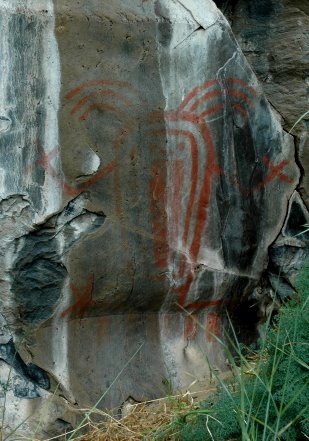
The rubbings are mostly of ancient images found on the Columbia River Plateau. The region is home to hundreds of petroglyphs that have been carved into the surface of the native basalt and also to many pictographs that are painted on the rock.

Some of the rubbings are especially interesting because they are of images that are now submerged in the pools behind the major dams on the Columbia.


The rubbings were done by artist Jeanne Hillis over a number of years beginning in the 1940's. Skamania Lodge developer John D. Gray (also famous for Salishan, John's Landing, etc.) acquired the entire Hillis collection in the early 1990's to provide an artistic theme for the new lodge. Well known rock art scholar Dr. James Keyser was commissioned to write a monograph on the collection titled Indian Petroglyphs of the Columbia Gorge: The Jeanne Hillis Rubbings which was published in 1994.

I hope you enjoy the images below...and appreciate that they represent an important aspect of a living culture that has existed in the Pacific Northwest for thousands of years.


In addition to the rubbings the lodge holds several major wood carvings with images inspired by Pacific coast Indian art.


All the images in this blog are viewable for free in the public areas of the lodge. It's well worth a stop if you're ever in the area.

Enjoy!

(The author received no compensation from Skamania Lodge (or anyone else) for this post.)

Sunday, December 5, 2010

Artist's Night, Cultural Trust, Machu Picchu & More

Its ARTIST'S NIGHT at the Oregon Archaeological Society! Next Tuesday is a special meeting...OAS artists will exhibit and sell their works, we''ll get a fascinating presentation on Captain Jack's Modoc Stronghold, and we get to select officers and board members for next year...art, education, and elections...all on one night! Plus OAS Basic Training, Oregon Cultural Trust, lectures, 10,000 year-old bones and Machu Picchu artifacts being returned to Peru...all that and more below. (The very artistic carved fish in the photo is 25,000 years old and is located in the Abri du Poisson near Les Eyzies-de-Tayac, France).


OAS MEETING & PRESENTATION: TUESDAY, DEC. 7 - CAPTAIN JACK'S STRONGHOLD
The results of recent archaeological field work of Captain Jack’s Stronghold in Lava Beds National Monument in Southern Oregon is the topic of the December 7, 2010 Oregon Archaeological Society lecture. A wildfire in 2008 burned covering vegetation from the “stronghold” and afforded archaeologists access and opportunity to better survey and study the area. The extensive honeycomb of jagged rock outcroppings, caves, and caverns provided Captain Jack and his Modoc tribe with an impregnable fortress and defensive position from which to fight extradition to a reservation by the U.S. Army in 1872-1873. The battle is referred to as the Modoc Indian War in Oregon history.

Jacqueline Cheung and Eric Gleason, both archaeologists with the National Park Service will present findings from their extensive field work, including the fortification and residential features and associated artifacts in the Stronghold. Using projected stereoscopic photographs (in 3-D) from the period, they will illustrate the historic features, battle fortifications, and examine changes in the landscape.


The presentation is at Oregon Museum of Science and Industry (OMSI) at 7:45 PM, and is free and open to the public. The talk is preceded at 7 PM by a general business meeting, which is also open to the public
See www.oregonarchaeological.org or call 503-727-3507 for more information.


2011 ARCHAEOLOGY FOR THE CURIOUS BASIC TRAINING PROGRAM

Do you want to prepare yourself to work on volunteer projects across the U.S.? Are you looking to learn more about archaeology basics, or do you need a refresher on the history of the Pacific Northwest? The Oregon Archaeological Society offers an annual training program that can help you accomplish all these goals.

OAS Basic Training, also known as Archaeology for the Curious, is taught by experienced regional professionals and volunteers from organizations such as the National Forest Service, BLM, and the University of Oregon.

Classes are held on Saturdays and begin in January 2011.

For all the details check: http://oregonarchaeological.org/training.htm


OREGON CULTURAL TRUST SUPPORTS OAS AND OTHER NON-PROFITS! MAKE DONATIONS BEFORE YEAR-END!


This is an important time for the Oregon Cultural Trust.

In the next month, the Trust will be reaching out to Oregonians and asking them to
make a contribution to support our state's unique cultural life and heritage. As you may know, the Trust has a goal of raising $4 million and dramatically increasing the number of donors from across the state by December 31st.

In the coming weeks, as we all spend time with our families, enjoy seasonal
performances and visit our most cherished venues and historic locations, we are asking that you take the time to make a donation to the Oregon Cultural Trust.

And in most cases, your donation will ultimately cost you absolutely nothing.

How? Through a tax credit on your state income tax for contributions to the Trust (keep in mind a tax credit is different than a tax deduction. Your tax bill is literally reduced by the amount of the credit!). To earn the tax credit:

First, make a donation to your favorite Oregon cultural non-profit (like OAS!). A list of qualifying 501(c)(3) non-profits (including OAS) is available at www.culturaltrust.org.

Second, make an equal or greater contribution to the Oregon Cultural Trust online at
www.culturaltrust.org.

Finally, claim your 100%, dollar for dollar tax credit for your gift to the Trust on your
Oregon state income tax (up to $500 for individuals, $1,000 for couples filing jointly and $2,500 for Oregon Corporations).

Supporting Oregon's culture couldn't be easier or more important. To learn more simply visit our website or contact the Trust via email at cultural.trust@state.or.us or by phoning 503 986 0088.

Thank you for taking the time to support Oregon's most valuable resource; our unique culture. Give the Gift That Grows. Donate today.


AIA LECTURES: JANUARY 21 & MARCH 11, 2011
January 21st 2011 - Friday 7:30 pm- School of Business Auditorium PSU
Ulrike Krotscheck, The Evergreen State College
“Wine for Bread: trade between Greek colonists and Gauls”

March 11th, 2011 - Friday 7:30 pm - School of Business Auditorium PSU
Thomas Tartaron, University of Pennsylvania
"Korphos-Kalamianos: Investigations at a Recently Discovered Mycenaean Harbor Town in the Corinthia, Greece, 2007-2010" (Dorinda J. Oliver Lecture)

All lectures are preceded by a no-host dinner; for details, and for ADA accommodations at lectures, please email Karen Carr at carrk@pdx.edu. All AIA events are free and open to the public. Free parking is available in the PSU parking structures after 5 pm on Fridays.

Check out the AIA website at http://www.history.pdx.edu/AIA.htm.


HISTORIC FILMS, CRAFTS SLATED FOR ASTORIA
The Columbia River Maritime Museum in Astoria will host a free
community day from 10 a.m.-5 p.m. Dec. 4. Crafts will focus on a few
of the cultures that depended or worked on the Columbia River. Historic
films shown throughout the day in the Kern Room. For a schedule of
events, visit the museum's website at www.crmm.org or join the museum on
its Facebook page.


MEXICAN ARCHAEOLOGISTS EXTRACT 10,000 YEAR-OLD SKELETON FROM FLOODED CAVE
MEXICO CITY.- One of the earliest human skeletons of America, which belonged to a person that lived more than 10,000 years ago, in the Ice Age, was recovered by Mexican specialists from a flooded cave in Quintana Roo. The information it has lodged for centuries will reveal new data regarding the settlement of the Americas.

Read the whole story at: http://goo.gl/MHI8L


YALE WILL RETURN MACHU PICCHU ARTIFACTS

Alan Garcia, president of Peru, announced on Friday that Yale University has committed to return a collection of artifacts from Machu Picchu in early 2011 -- possibly ending years of negotiations and legal threats over the pieces, which were taken by a Yale team that excavated the area a century ago. Peru has long disputed Yale's assertions that the artifacts were taken legally.

Read the whole story at: http://goo.gl/ZYOOR

(Thanks to Oregon Heritage News, Russel Micnhimer, AIA, ArtDaily.org, and Inside Higher Ed for some of the content of this message.)

Friday, October 29, 2010

OAS eNews: Breaking Info on Events, Discoveries, and More

OAS Meeting & Presentation: Tuesday, Nov. 2
“Archaeology in the Oregon State Park System” is the title of the November 2, 2010 lecture sponsored by the Oregon Archaeological Society. From the Oregon coast to the Willamette Valley to John Day, Oregon’s state parks are the stewards of Oregon’s history, which is revealed in the cultural sites found within many of the parks. Nancy Nelson, Oregon State Parks and Recreation Department archaeologist, will provide
information on an array of archaeological site types found in state parks. Both precontact and historic archaeological sites will be highlighted, including Tseriadun, Fort Yamhill, and Kam Wah Chung.

Nelson received her education from Oregon State University and the University of Oregon in Anthropology. She has a broad range of experience working on archaeological and cultural resource projects in conjunction with the Coquille tribe; Confederated Tribes of the Coos, Lower Umpqua and Suislaw; the Yakima Nation; and the Ak-Chin Indian Community in Arizona.

The presentation is at Oregon Museum of Science and Industry (OMSI) at 7:45 PM, and is free and open to the public. The talk is preceded at 7 PM by a general business meeting, which is also open to the public

See www.oregonarchaeological.org or call 503-727-3507 for more information.

AIA Lecture: Friday, Nov. 12
November 12, 2010 - Friday 7:30 pm - School of Business Auditorium PSU
Susann Lusnia, Tulane University
“The Petrified City: Reading the Marble Plan of Rome”

Washougal Pedestrian/Petroglyph Tunnel Complete
...A Somewhat Tardy Report

After months of work the Petroglyph tunnel in Washougal had its grand opening in mid-August. Well over 100 people came to the celebration (including several OAS members!) and were treated to speeches by Rep. Brian Baird, the current and a couple of former Washougal mayors, other dignitaries...and yours truly.

If you're near Washougal the tunnel is well worth a visit. You can find it by simply heading for the Pendleton Woolen Mills Outlet Store (also fun to visit), parking in their lot and looking south toward the river.

The City of Washougal deserves a lot of credit for building what will be a lasting addition to the community.

(Left to right) Washougal High intern Patrick McCarthy, Washougal Councilwomen and project team member Molly Coston, Project Advisor Mike Taylor standing with "See Who Watches" panel.

Three more of the seven panels in the tunnel.

Read more at: http://www.columbian.com/news/2010/jul/13/we-helped-guide-them-to-build-something-that-would/

See more photos and info at: http://culturewatchnorthwest.blogspot.com/2010/02/petroglyph-tunnel-entry-stone.html

Two Books to be Released Online
Two ground-breaking works on relations between Native Americans and early Pacific Northwest settlers will be released online this week by Oregon State University in celebration of the fourth annual International Open Access Week.

The OSU Press and the OSU Center for Digital Scholarship and Services are making available Theodore Stern¹s two-volume works, "Chiefs and Chief Traders: Indian Relations at Fort Nez Percés, 1818-1855," and "Chiefs and Change in the Oregon Country." First published by OSU Press in the 1990s,the books have been out of print for several years.

The books are free online as high-resolution, searchable PDF files in the press's collection in the ScholarsArchive@OSU open access repository: http://ir.library.oregonstate.edu/xmlui/handle/1957/18857

Raven Bluff: another dated Alaskan fluted point site
Northwest Coast Archaeology
qmackie | October 26, 2010
"Some time ago I (Mackie) posted about the Serpentine Hot Springs site in Northwestern Alaska, at which several fluted points have been found, apparently dating to about 12,000 years ago. That’s about a thousand years more recent than Clovis, which is the best known of the early “fluted point” archaeological cultures from the Americas. I was interested to come across another site – Raven Bluff – which has recently come to light from the same general area, and which also has fluted points. At Raven Bluff, at least one of these dates to between about 12,000 and 12,500 years ago – also younger than Clovis, which is mainly confined to a narrow window around 13,000 years ago..."

Read the whole story at: http://goo.gl/nsw4

Rock Spirits at the Portals to Afterlife
By Andrew Howley
A 14,000-year-old bone flute found inside Bédeilhac cave.
The final day of the 2010 IFRAO conference on Pleistocene Art of the World continued to present innovative approaches and fascinating discoveries about the well-known but little understood world of prehistoric rock art.

Tarascon-sur-Ariège, France--Anderzej Rozwadowski gave some enlightenment about the significance of rock itself to Siberian shaman culture, showing how parts of it may match up well with Paleolithic rock art traditions. Among some of these groups, when people die, they are seen as going to an afterlife that exists within the Earth's rock. Cracks and caves are then powerful places that can serve as passages between our world and theirs.

Rozwadowski also pointed out that often in Siberian rock art, images of a drummer (presumably a shaman) are paired with a wounded or hunted animal. If ethnographic evidence can identify this as a current symbol of human death, we may be one step closer to understanding similar images from elsewhere, including the famously mysterious scene of an aggressive wounded bison facing a human-like figure who could be falling backward, in a deep shaft at Lascaux...

Read the whole story at: http://goo.gl/tGqh
More at: http://goo.gl/eA5d

Vandals Strike N. Arizona Archaeological Site
By: Associated Press

WILLIAMS, AZ - Archaeologists are assessing damage to a 1,000 year-old rock art panel in a northern Arizona forest.

A hiker reported the damage last month at the Kaibab National Forest's Keyhole Sink, named for the keyhole-shaped lava flow.

Read more at: http://www.abc15.com/dpp/news/region_northern_az/other/vandals-strike-n.-arizona-archaeological-site


Aged 9,000 Years, Ancient Beer Finally Hits Stores
by BRAD HORN
NPR

Dogfish Head brewery is known for making exotic beer with ingredients like crystallized ginger or water from Antarctica, so it might not sound surprising that one of its recent creations is a brew flavored simply by grapes and flowers. It's not the recipe that makes this beer so special; it's where that recipe was found: a Neolithic burial site in China...


Read the whole story at: http://goo.gl/dA9t

Subterranean Secrets-New Rock Art Discovery in Borneo Subterranean Secrets
Photograph by Robbie Shone, Barcroft/Fame Pictures

Caver Andy Eavis compares his hand size with painted prints on the walls of the recently discovered Black Hands Cave, part of the massive Gunung Mulu cave system in the Malaysian section of the island of Borneo...

Read the whole story at: http://goo.gl/QSoP


(Thanks to Oregon Heritage News, Northwest Coast Archaeology Blog, National Geographic, AIA, and Robin Harrower, Pat Lyttle, and Jodi Lorimer for some of the info in this message.)


Copyright (C) 2010 CultureWatch Northwest All rights reserved. Previously copyrighted material is the property of the copyright holder.