For tickets email: culturewatch@gmail.com

Showing posts with label anthropology. Show all posts
Showing posts with label anthropology. Show all posts
Saturday, June 7, 2014


Tuesday, January 1, 2013
Petroglyph Canyon Historic Photos
 |
| Large wall of rock art at Petroglyph Canyon (Willis Vail Photo, 1905. © Old Oregon Photos.) |

View of Petroglyph Canyon location. Columbia Hills State Park is at the red "You Are Here" dot (image courtesy of Washington State Parks)
Petroglyph Canyon was reported to have one of the largest concentrations of Indian rock art in North America before it was largely submerged in the pool behind The Dalles Dam (photo below) in 1957. Today much of the rock art, and the canyon itself, lie hidden beneath the waters of Horsethief Lake and the Columbia River at Columbia Hills State Park near Dallesport, WA.

We recently came across a website (www.oldoregonphotos.com) that displays (and sells) historic photographs. John Klatt, who owns the Old Oregon website, has graciously allowed CultureWatch NW to reproduce some very old photos of Columbia Gorge rock art. (All historic photos in this post are © Old Oregon Photos).
As the giant hydroelectric generation dams were built on the Columbia River beginning in the 1930's many Native American cultural areas, including rock art sites, were flooded by the large lakes that formed behind them. Photographers, professional and amateur, scrambled to record the ancient images before they disappeared.
By the way, if you have old photos of rock art from the Columbia Gorge and are willing to share them we would love to hear from you! Just send an email to culturewatch@gmail.com.
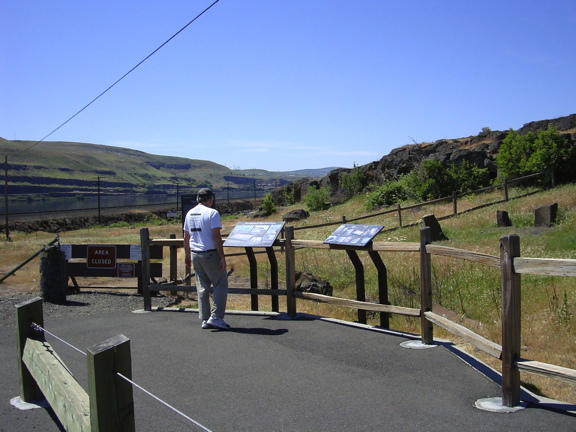
A number of petroglyphs and pictographs were actually "salvaged" by being physically removed from areas about to be submerged. Some of these rescued boulders, including a number of those shown in the old Benjamin Markham photos in this article, can be seen today along the Temani Peshwa Trail (photo below) at Columbia Hills State Park and at the Ginkgo Petrified Forest Recreation Area near Vantage, WA.

So let's take a look at the old photos! When available we've included both a historic picture (black and white) and a modern photo (color) so you can see how the rock art has changed in the last 75-100 years.
As the giant hydroelectric generation dams were built on the Columbia River beginning in the 1930's many Native American cultural areas, including rock art sites, were flooded by the large lakes that formed behind them. Photographers, professional and amateur, scrambled to record the ancient images before they disappeared.
By the way, if you have old photos of rock art from the Columbia Gorge and are willing to share them we would love to hear from you! Just send an email to culturewatch@gmail.com.
A number of petroglyphs and pictographs were actually "salvaged" by being physically removed from areas about to be submerged. Some of these rescued boulders, including a number of those shown in the old Benjamin Markham photos in this article, can be seen today along the Temani Peshwa Trail (photo below) at Columbia Hills State Park and at the Ginkgo Petrified Forest Recreation Area near Vantage, WA.
So let's take a look at the old photos! When available we've included both a historic picture (black and white) and a modern photo (color) so you can see how the rock art has changed in the last 75-100 years.
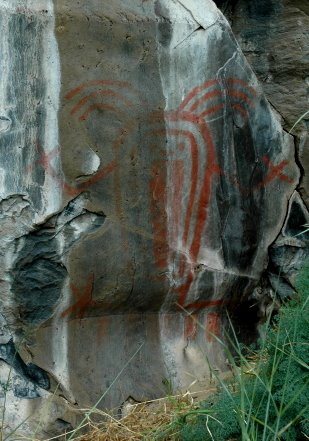
The photo on the left below was taken by Benjamin Markham in the 1920's. It shows the panel of petroglyphs in situ, still part of the cliff wall at Petroglyph Canyon. The same panel is visible at center left in the Willis Vail photo above. On the right below is the salvaged panel, now located on the Temani Peshwa Trail.


You will notice that the contrast between the petroglyphs and the background rock is much greater in the old photos. Historically it was a common practice to color or outline rock art with white chalk to make the images show up clearly in photos. This practice is now regarded as vandalism because it may take decades for the chalk to disappear.


You will notice that the contrast between the petroglyphs and the background rock is much greater in the old photos. Historically it was a common practice to color or outline rock art with white chalk to make the images show up clearly in photos. This practice is now regarded as vandalism because it may take decades for the chalk to disappear.

Images in situ at Petroglyph Canyon.
Markham Photo.
| ||
 
Images in situ at Petroglyph Canyon (at left above, Markham Photo circa 1920's) and as they looks today on the Temani Peshwa Trail at Columbia Hills State Park.

The photo on the left (attributed to Markham but unsigned) was taken near Wishram, WA. A modern photo shows the beautiful color of the images which are a combination of petroglyphs and pictographs (painted on the rock surface).

The two photos below were also taken by Markham
in the 1920's. Unfortunately we don't have any modern photos to compare them with. The image on the left was taken in Petroglyph Canyon and is now assumed to be submerged. The other was taken at a rock art site in Sherman County, Oregon.   Check out the historic photos at www.oldoregonphotos.com and when the weather warms up (after April 1) head out to Columbia Hills State Park where you can take a self-guided tour of the Tamani Peshwa Trail (whenever the park is open) and also a free guided tour of the other extensive rock art sites at the park (reservation required for the free tour, there is a small fee to enter the park). |

Sunday, November 6, 2011
New e-Book! "In the Footsteps of the Fremont...The Rock Art of Minnie's Gap, Wyoming"
CultureWatch Northwest is pleased to publish this free e-book for your education and enjoyment! We've used an on-line service called Shutterfly to produce the book and make it freely available on our website. You can read the full book by clicking below and you can purchase a printed copy from Shutterfly if you like (CultureWatch receives none of the proceeds).
The Minnie's Gap site was first scientifically surveyed and reported in 1962 by the University of Utah in conjunction with the construction of the Flaming Gorge Dam and Reservoir. In 2011, Archaeologist and Team leader Dr. James D. Keyser recognized two of the drawings in the report as important Fremont Culture (ca. AD 700-1200) symbolism and organized the project to professionally study them.
We hope you enjoy this look at the beautiful rock art of Minnie's Gap, Wyoming!
From the book...
Click here to view this photo book larger
"In June 2011 a team of archaeologists from the Oregon Archaeological Society and CultureWatch Northwest surveyed, photographed, and recorded the important ancient Indian rock art at the Minnie's Gap, Wyoming site.
The Minnie's Gap site was first scientifically surveyed and reported in 1962 by the University of Utah in conjunction with the construction of the Flaming Gorge Dam and Reservoir. In 2011, Archaeologist and Team leader Dr. James D. Keyser recognized two of the drawings in the report as important Fremont Culture (ca. AD 700-1200) symbolism and organized the project to professionally study them.
The team (below) sincerely appreciates the cooperation of landowners Pat and Pauleen Baker of Dutch John, Utah who allowed us to access the site and we dedicate this volume to them."
Michael Taylor, CultureWatch Northwest/Oregon Archaeological Society
Dr. James D. Keyser, Oregon Archaeological Society
George Poetschat, Oregon Archaeological Society
David Kaiser, Oregon Archaeological Society
Steve Rathman, Oregon Archaeological Society
Friday, September 2, 2011
People & Plants: Study of Ancient Oregon Rock Shelter Topic of September OAS Lecture
 |
| Catlow Valley Highway-Photo Courtesy of Dave Anderson (Picasa) |
The Oregon Archaeological Society will offer its first lecture of the year on Tuesday, September 6, 2011. The title of the lecture is “People and Plants: Paleobotanical Studies at a Late Archaic Rock Shelter in Oregon’s Catlow Valley.” Jaime Dexter, a doctoral student in Archaeology at the University of Oregon, is the featured speaker.
Dexter’s research interests include paleoethnobotany, palynology, plant genetics, and environmental archaeology. She has studied the subsistence strategies of hunter-gatherer populations in the northwestern Great Basin and is specifically interested in utilizing cross-disciplinary approaches to recognize and address prehistoric environmental impacts.
The presentation is at the Oregon Museum of Science and Industry (OMSI) at 7:45 PM, and is free and open to the public. The talk is preceded at 7 PM by a general business meeting, which is also open to the public
See www.oregonarchaeological.org or call 503-727-3507 for more information.www.oregonarchaeological.org.
OAS Field Trip: Huckleberry Processing Fields, Saturday, September 10 - Space Available!
Rick McClure, Forest Archaeologist & Heritage Program Manager for the Gifford Pinchot National Forest at Mt. Adams, Washington and archaeologist Cheryl Mack, will conduct two field trips to huckleberry processing field sites, focusing on the archaeology of the Cascade Crest - late summer upland use oriented toward collection and processing of huckleberries. The trip is expected to last the entire day.
 |
| Photo courtesy Fat of the Land |
Meet at 9:00 a. m. at the Mt. Adams Ranger Station. This trip will go into the Indian Heaven Wilderness and is more difficult due to hiking conditions.
Contact Betty Tandberg (360) 695-6021 or tandberg0408@comcast.net to sign up for either of these trips since the number of participants is limited.
Final Resting Place of Clark County Pioneers

Columbian Staff Reporter
It wasn’t easy for the dozen or so family members to pack up a wagon train in 1850 and bump, thump and roll their way from Missouri to what would eventually become east Vancouver.
When they staked their claims for free land around the Columbia River and Government Island, the small band probably didn’t consider that one day they’d end up as founding members of a county that would grow to more than 425,000 people...
Read the whole story at: Fishers Cemetery
British Columbia Village May Be 10,000 Years Old
Mark HumeWhen they staked their claims for free land around the Columbia River and Government Island, the small band probably didn’t consider that one day they’d end up as founding members of a county that would grow to more than 425,000 people...
Read the whole story at: Fishers Cemetery
British Columbia Village May Be 10,000 Years Old
Globe & Mail

But shortly after the team from the University of Northern British Columbia started to sink pits into a shell midden (refuse dump) on the Central Coast, he realized it was much bigger than anyone imagined – so large he now believes it is part of a long-lost, ancient village called Luxvbalis...
Read the whole story at: Ancient Village

When Farid Rahemtulla and his anthropology students began to dig in the forest floor on Calvert Island, he pretty much knew what to expect – lots of clam and mussel shells.
But shortly after the team from the University of Northern British Columbia started to sink pits into a shell midden (refuse dump) on the Central Coast, he realized it was much bigger than anyone imagined – so large he now believes it is part of a long-lost, ancient village called Luxvbalis...
Read the whole story at: Ancient Village
By Jeff German
Las Vegas Review-Journal


The desecration last year of prehistoric artwork at the Red Rock Canyon National Conservation Area sparked outrage and focused attention on the spread of graffiti throughout the Las Vegas Valley.
This week, the 17-year-old youth charged with defacing the Red Rock area received his punishment behind closed doors in federal court, ending a case that rallied the community to help remove the spray-painted graffiti...
This week, the 17-year-old youth charged with defacing the Red Rock area received his punishment behind closed doors in federal court, ending a case that rallied the community to help remove the spray-painted graffiti...
Read the whole sad story at: Rock Art Graffiti
By Brandon Keim
Wired
A fresh analysis of Ötzi the Iceman’s stomach suggests a grisly new climax to the world’s most famous prehistory murder mystery: death by ambush, a surprise killing in the afterglow of a big meal.
Ötzi was found in 1991, frozen and fantastically preserved in ice high in the Italian Alps, where he’d perished 5,300 years ago. With his tattoos and cool tools and smart outfit, rendered by artists with soulful brown eyes under a weathered brow, he became a Copper Age celebrity. Public and scientific imagination seized on the circumstances of his life — and, of course, his death...
Otzi fans can read the whole story at: Otzi Dies on Full Stomach
By Ian Sample
Guardian.co.uk

A recent discovery suggests early humans were wielding sophisticated stone tools at least 300,000 years earlier than thought. A rare haul of picks, flakes and hand axes recovered from ancient sediments in Kenya are the oldest remains of advanced stone tools yet discovered.
Archaeologists unearthed the implements while excavating mudstone banks on the shores of Lake Turkana in the remote north-west of the country.
Archaeologists unearthed the implements while excavating mudstone banks on the shores of Lake Turkana in the remote north-west of the country.
Read the whole story at: Ancient Tools
(Thanks to Robin Harrower, Russel Micnhimer, The Columbian, Wired, the Guardian, The Globe and Mail, and Las Vegas Review-Journal for some of the info in this post.)
Sunday, April 3, 2011
Warrior Art, Painted Caves, Flint-knapping, Mammoths ...and More
 OAS MEETING: TUESDAY, APRIL 5, 7:00 PM AT OMSI
“Recounting Days of Glory: Plains Indian Warrior Art” is the topic of the April 5, 2011 Oregon Archaeological Society lecture. Dr. James Keyser is the featured speaker.
Keyser has conducted rock art research across western North America including projects in Alberta, South Dakota, Montana, Wyoming, Colorado, Utah, Oregon, Washington, and Alaska. He also has an ongoing research interest in European rock art in France, Spain, and Italy. He is a member of the Science Advisory Committee for the Study of Chauvet Cave (France), and is listed in Who's Who in Rock Art. Prior to retirement, he served for 27 years as a regional archaeologist for the U.S. Forest Service. He maintains faculty affiliation with the University of Montana and has more than 150 archaeology publications of which more than 100 concern rock art, robe art, or ledger art.
The presentation is at Oregon Museum of Science and Industry (OMSI) at 7:45 PM, and is free and open to the public. The talk is preceded at 7 PM by a general business meeting, which is also open to the public
See www.oregonarchaeological.org or call 503-727-3507 for more information.
JEAN AUEL BOOKSIGNING AT THE OAS MAY MEETING

As you've probably heard by now Jean Auel has released a new book "The Land of Painted Caves"! Jean has tentatively agreed to come to the May OAS meeting to sign copies of her new book (if she's back from her intergalactic book launch tour).
OAS will have a few copies of the new book that you can buy at the meeting or you can bring your own.
We'll make another announcement later in April to confirm (or reschedule) the booksigning.
Read a great Oregonian article about Jean Auel at: "Where I Write: Jean M. Auel..."
OAS PRESIDENT DEMONSTRATES FLINT-KNAPPING AT FORT VANCOUVER

Dennis Torresdal, OAS President, was featured in a recent Columbian article titled "Flint-Knapping Fun". Dennis, an expert flint-knapper, created fine blades, projectile points...and a lot of debitage during a well-attended exhibition at the Fort.
Read all about it at: Fort Vancouver Flint-knapping
WENAS CREEK MAMMOTH EXCAVATIONS: LECTURE APRIL 11

Monday, April 11, 6:30 PM, Columbia Gorge Interpretive Center, 990 SW Rock Creek Dr., Stevenson, WA, Patrick Lubinski, Wenes Creek Mammoth.
Lecturer: Patrick Lubinski, Professor of Anthropology, Central Washington University.
The 2005 accidental discovery of a mammoth bone near Selah, Washington led to a six- year investigation by Central Washington University, providing a glimpse into life during that time. In addition to 16,000-year-old mammoth and bison bones, students and faculty have found human-made artifacts of unknown age that could shed new light on the early presence of people in Washington. Lubinski will summarize the project and its findings using bone casts, PowerPoint images and video. .
http://www.humanities.org/programs/speakers/current-speakers/inquiring-mind-speaker-patrick-lubinski
As this is an evening event the Interpretive Center will be closed. After you turn north on Rock Creek Drive from Washington SR14 look for the employees entrance/parking lot on your right (less than 1/2mile). If you get to Skamania Lodge Road or the main entrance to the Interpretive Center you have gone too far.
For more info: Patrick Lubinski
CENTER FOR JAPANESE STUDIES HOSTS PSU TALK MAY 19
May 19, 6PM PSU Smith Memorial Hall 238 presentation by DR. Ho Tae JEon (Harvard University) "Koguryo tomb murals and Japan in Ancient East Asian Funeral Arts" sponsored by the Portland State Center for Japanese Studies.
$10,000 FINE LEVIED..."NO, IT'S NOT COOL TO DEFACE NATIVE ROCK ART

Read more: Rock Art Fine
Tuesday, December 28, 2010
Archaeology Presentations, Rock Art Guide, Old Teeth, & A Third Branch of Humanity
 OAS MEETING - TUESDAY, JAN. 4, 2011 - Revisiting the Meier Site
Dr. Kenneth Ames is the featured speaker at the January 4, 2011 Oregon Archaeological Society meeting. He will be talking about the Meier Site and Lower Columbia River archaeology.
The Meier Site, located near Scappoose, Oregon, is one of the most significant sites on the Lower Columbia River. It was excavated between 1987 and 1991. The site dates to the period from about AD 1400 to at least through the founding of Ft. Vancouver, in the 1830s and beyond. The Meier site revealed major residential habitation with a massive plankhouse. The talk reviews the results of analyses of thousands of artifacts, focusing on the Meier site, while also discussing other sites along the river.
Dr. Ames is Professor and Department Chair of Anthropology at Portland State University. He has conducted numerous archaeological field research in western North America and has authored numerous publications and reports.
The lecture will be held in the OMSI auditorium at 7:45 PM, and is free and open to the public. The presentation is preceded at 7 PM by a general business meeting, which is also open to the public. See www.oregonarchaeological.org or call 503-727-3507 for information.
ARCHAEOLOGY FOR THE CURIOUS-OAS BASIC TRAINING STILL AVAILABLE!
Are you looking to learn more about archaeology basics, or do you need a refresher on the history of the Pacific Northwest? The Oregon Archaeological Society offers an annual Training program.
OAS Basic Training, also known as Archaeology for the Curious, is taught by experienced regional professionals from organizations such as the National Forest Service, BLM, and the University of Oregon. The sessions will be held on six Saturdays in late Winter/early Spring.
Contact Steve Satterthwaite (503) 824-2264 satterts@hotmail.com or visit http://www.oregonarchaeological.org/training.htm
NEW ROCK ART GUIDE BOOK NOW AVAILABLE
 Oregon avocational archaeologists D. Russel Micnhimer and LeeAnn Johnston announce the publication of their new guide book, Where to See Rock Art: Washington Oregon Idaho by Pendulum Press.
It contains general information about various aspects of rock art and specific information about where rock art can be seen in museums, visitor centers, state parks and public lands in Washington, Oregon and Idaho. Photographs, line drawings and a brief description give readers an idea of what they will find at 39 locations in the three states. The table of contents make it easy to access the information in this 147 page paperback.
The authors are members of the Oregon Archaeological Society and have received numerous Loring & Loring Grants from the organization in support of their on going research and website www.oregonrockart.com.
The new book is available directly from Russel Micnhimer, P. O. Box 1653, Prineville, OR 97754. $14.95 + $4.00 S&H (USPS). For more information email TalkingEarth@hotmail.com.
(I've read Russel and LeeAnn's new book and its a great guide for anyone who wants to visit the very interesting public rock art sites of the Pacific Northwest...Mike)
DOUGLAS HISTORIAN TO SPEAK IN PORTLAND, VANCOUVER
Author Jack Nisbet will talk about "Point of Departure: David Douglas at Fort Vancouver 1825-33" at 2 p.m. Jan. 9 at E.B. Hamilton Hall on the Fort Vancouver National Site. Nisbet will also give a reading from his book "The Collector: David Douglas and the Natural History of the Northwest" at 7:30 p.m. Jan. 10 at Powell's bookstore in downtown Portland.
Douglas was the premier botanical explorer in the Pacific Northwest and western North America in the 19th century. His base of operations always remained at Fort Vancouver. The people he met there influenced his every move, and the changes he witnessed during his visits mark significant turning points for the social, economic, scientific, and environmental stories of the region. In this illustrated presentation at Fort Vancouver, Nisbet traces the energy Douglas brought to, and absorbed from, his central headquarters at Fort Vancouver. Nisbet is this year's Michael M. Powell Fellow at the Center for Columbia River History.
For program information, go to http://www.ccrh.org/calendar.php
AN OLDER ORIGIN FOR 'MODERN' TOOL-MAKING TECHNIQUE?
By News Services-October 29, 2010
 A technique for shaping stones into sharp-edged points may have emerged about 55,000 years earlier than previously known, according to a study of stone tools from Blombos Cave in South Africa. Previously, researchers have also found other evidence of “modern” human behavior, such as shell beads, from this 75,000-year-old site, where new ideas and techniques may have been rapidly introduced...
Read the whole story at: http://www.flickeringtorches.com/2010/10/29/an-older-origin-for-modern-tool-making-technique.html
HUMAN, NEANDERTHAL, OR OTHER?
Finger Bones Point to New Branch of Humanity
By Charles Q. Choi
Published December 22, 2010
LiveScience
 A finger bone and other remains from Siberia now reveals a previously unknown group of ancient humans once existed there, one neither like us nor Neanderthals.
Bizarrely, the DNA from these extinct Siberians seems unusually similar to that of Pacific Islanders from tropical Melanesia.The 30,000-year-old fossil was found in Denisova Cave in southern Siberia in 2008, a bone fragment that likely came from a fingertip of a young girl. It was discovered along with microblades (small stone blades used as tools), body ornaments of polished stone, and a molar shaped very differently from that of Neanderthals and modern humans, resembling that of much older human species, such as Homo habilis and Homo erectus. (The tooth and the finger bone apparently came from different members of the same population.)...
Read more: New Branch of Humanity?
More at: Three Types of Ancient Humans?
RESEARCHERS: ANCIENT HUMAN REMAINS FOUND IN ISRAEL
By Daniel Estrin
Associated Press – Mon Dec 27
 JERUSALEM –Israeli archaeologists said Monday they may have found the earliest evidence yet for the existence of modern man, and if so, it could upset theories of the origin of humans. A Tel Aviv University team excavating a cave in central Israel said teeth found in the cave are about 400,000 years old and resemble those of other remains of modern man, known scientifically as Homo sapiens, found in Israel. The earliest Homo sapiens remains found until now are half as old...
Read the whole story at: Ancient Teeth
ANCIENT ROCK ART'S COLOURS COME FROM MICROBES
BBC Mobile
December 27, 2010

A particular type of ancient rock art in Western Australia maintains its vivid colours because it is alive, researchers have found...
Read more at: http://goo.gl/eAEFH
(Thanks to Oregon Heritage News, News Services, LiveScience, the Associated Press, Russel Micnhimer, and Jodi Lorimer for some of the info in this message).
Sunday, December 12, 2010
The Petroglyph Rubbings at Skamania Lodge
 I was lucky enough to get to attend a Christmas party at Skamania Lodge in Stevenson, WA this weekend.
Very nice place and they have an excellent collection of petroglyph rubbings and Pacific coast Indian-inspired wood carving displayed throughout the hotel.
The rubbings are mostly of ancient images found on the Columbia River Plateau. The region is home to hundreds of petroglyphs that have been carved into the surface of the native basalt and also to many pictographs that are painted on the rock.
Some of the rubbings are especially interesting because they are of images that are now submerged in the pools behind the major dams on the Columbia.

The rubbings were done by artist Jeanne Hillis over a number of years beginning in the 1940's. Skamania Lodge developer John D. Gray (also famous for Salishan, John's Landing, etc.) acquired the entire Hillis collection in the early 1990's to provide an artistic theme for the new lodge. Well known rock art scholar Dr. James Keyser was commissioned to write a monograph on the collection titled Indian Petroglyphs of the Columbia Gorge: The Jeanne Hillis Rubbings which was published in 1994.

 I hope you enjoy the images below...and appreciate that they represent an important aspect of a living culture that has existed in the Pacific Northwest for thousands of years.


In addition to the rubbings the lodge holds several major wood carvings with images inspired by Pacific coast Indian art.


All the images in this blog are viewable for free in the public areas of the lodge. It's well worth a stop if you're ever in the area.
Enjoy!
(The author received no compensation from Skamania Lodge (or anyone else) for this post.)
Friday, October 29, 2010
OAS eNews: Breaking Info on Events, Discoveries, and More
OAS Meeting & Presentation: Tuesday, Nov. 2
“Archaeology in the Oregon State Park System” is the title of the November 2, 2010 lecture sponsored by the Oregon Archaeological Society. From the Oregon coast to the Willamette Valley to John Day, Oregon’s state parks are the stewards of Oregon’s history, which is revealed in the cultural sites found within many of the parks. Nancy Nelson, Oregon State Parks and Recreation Department archaeologist, will provide
information on an array of archaeological site types found in state parks. Both precontact and historic archaeological sites will be highlighted, including Tseriadun, Fort Yamhill, and Kam Wah Chung.
Nelson received her education from Oregon State University and the University of Oregon in Anthropology. She has a broad range of experience working on archaeological and cultural resource projects in conjunction with the Coquille tribe; Confederated Tribes of the Coos, Lower Umpqua and Suislaw; the Yakima Nation; and the Ak-Chin Indian Community in Arizona.
The presentation is at Oregon Museum of Science and Industry (OMSI) at 7:45 PM, and is free and open to the public. The talk is preceded at 7 PM by a general business meeting, which is also open to the public
See www.oregonarchaeological.org or call 503-727-3507 for more information.
AIA Lecture: Friday, Nov. 12
November 12, 2010 - Friday 7:30 pm - School of Business Auditorium PSU
Susann Lusnia, Tulane University
“The Petrified City: Reading the Marble Plan of Rome”
Washougal Pedestrian/Petroglyph Tunnel Complete
...A Somewhat Tardy Report After months of work the Petroglyph tunnel in Washougal had its grand opening in mid-August. Well over 100 people came to the celebration (including several OAS members!) and were treated to speeches by Rep. Brian Baird, the current and a couple of former Washougal mayors, other dignitaries...and yours truly.
If you're near Washougal the tunnel is well worth a visit. You can find it by simply heading for the Pendleton Woolen Mills Outlet Store (also fun to visit), parking in their lot and looking south toward the river.
The City of Washougal deserves a lot of credit for building what will be a lasting addition to the community.
Three more of the seven panels in the tunnel.

Read more at: http://www.columbian.com/news/2010/jul/13/we-helped-guide-them-to-build-something-that-would/
See more photos and info at: http://culturewatchnorthwest.blogspot.com/2010/02/petroglyph-tunnel-entry-stone.html
Two Books to be Released Online
Two ground-breaking works on relations between Native Americans and early Pacific Northwest settlers will be released online this week by Oregon State University in celebration of the fourth annual International Open Access Week.
The OSU Press and the OSU Center for Digital Scholarship and Services are making available Theodore Stern¹s two-volume works, "Chiefs and Chief Traders: Indian Relations at Fort Nez Percés, 1818-1855," and "Chiefs and Change in the Oregon Country." First published by OSU Press in the 1990s,the books have been out of print for several years.
The books are free online as high-resolution, searchable PDF files in the press's collection in the ScholarsArchive@OSU open access repository: http://ir.library.oregonstate.edu/xmlui/handle/1957/18857
Raven Bluff: another dated Alaskan fluted point site
Northwest Coast Archaeology
qmackie | October 26, 2010
 "Some time ago I (Mackie) posted about the Serpentine Hot Springs site in Northwestern Alaska, at which several fluted points have been found, apparently dating to about 12,000 years ago. That’s about a thousand years more recent than Clovis, which is the best known of the early “fluted point” archaeological cultures from the Americas. I was interested to come across another site – Raven Bluff – which has recently come to light from the same general area, and which also has fluted points. At Raven Bluff, at least one of these dates to between about 12,000 and 12,500 years ago – also younger than Clovis, which is mainly confined to a narrow window around 13,000 years ago..."
Read the whole story at: http://goo.gl/nsw4
Rock Spirits at the Portals to Afterlife
By Andrew Howley
 A 14,000-year-old bone flute found inside Bédeilhac cave.
The final day of the 2010 IFRAO conference on Pleistocene Art of the World continued to present innovative approaches and fascinating discoveries about the well-known but little understood world of prehistoric rock art.
Tarascon-sur-Ariège, France--Anderzej Rozwadowski gave some enlightenment about the significance of rock itself to Siberian shaman culture, showing how parts of it may match up well with Paleolithic rock art traditions. Among some of these groups, when people die, they are seen as going to an afterlife that exists within the Earth's rock. Cracks and caves are then powerful places that can serve as passages between our world and theirs.
Rozwadowski also pointed out that often in Siberian rock art, images of a drummer (presumably a shaman) are paired with a wounded or hunted animal. If ethnographic evidence can identify this as a current symbol of human death, we may be one step closer to understanding similar images from elsewhere, including the famously mysterious scene of an aggressive wounded bison facing a human-like figure who could be falling backward, in a deep shaft at Lascaux...
Read the whole story at: http://goo.gl/tGqh
More at: http://goo.gl/eA5d
By: Associated Press
WILLIAMS, AZ - Archaeologists are assessing damage to a 1,000 year-old rock art panel in a northern Arizona forest.
A hiker reported the damage last month at the Kaibab National Forest's Keyhole Sink, named for the keyhole-shaped lava flow.
Read more at: http://www.abc15.com/dpp/news/region_northern_az/other/vandals-strike-n.-arizona-archaeological-site
Aged 9,000 Years, Ancient Beer Finally Hits Stores
by BRAD HORN
NPR
Dogfish Head brewery is known for making exotic beer with ingredients like crystallized ginger or water from Antarctica, so it might not sound surprising that one of its recent creations is a brew flavored simply by grapes and flowers. It's not the recipe that makes this beer so special; it's where that recipe was found: a Neolithic burial site in China...
Read the whole story at: http://goo.gl/dA9t
Subterranean Secrets-New Rock Art Discovery in Borneo Subterranean Secrets
 Photograph by Robbie Shone, Barcroft/Fame Pictures
Caver Andy Eavis compares his hand size with painted prints on the walls of the recently discovered Black Hands Cave, part of the massive Gunung Mulu cave system in the Malaysian section of the island of Borneo...
Read the whole story at: http://goo.gl/QSoP
(Thanks to Oregon Heritage News, Northwest Coast Archaeology Blog, National Geographic, AIA, and Robin Harrower, Pat Lyttle, and Jodi Lorimer for some of the info in this message.)
Copyright (C) 2010 CultureWatch Northwest All rights reserved. Previously copyrighted material is the property of the copyright holder.
“Archaeology in the Oregon State Park System” is the title of the November 2, 2010 lecture sponsored by the Oregon Archaeological Society. From the Oregon coast to the Willamette Valley to John Day, Oregon’s state parks are the stewards of Oregon’s history, which is revealed in the cultural sites found within many of the parks. Nancy Nelson, Oregon State Parks and Recreation Department archaeologist, will provide
information on an array of archaeological site types found in state parks. Both precontact and historic archaeological sites will be highlighted, including Tseriadun, Fort Yamhill, and Kam Wah Chung.
Nelson received her education from Oregon State University and the University of Oregon in Anthropology. She has a broad range of experience working on archaeological and cultural resource projects in conjunction with the Coquille tribe; Confederated Tribes of the Coos, Lower Umpqua and Suislaw; the Yakima Nation; and the Ak-Chin Indian Community in Arizona.
The presentation is at Oregon Museum of Science and Industry (OMSI) at 7:45 PM, and is free and open to the public. The talk is preceded at 7 PM by a general business meeting, which is also open to the public
See www.oregonarchaeological.org or call 503-727-3507 for more information.
AIA Lecture: Friday, Nov. 12
November 12, 2010 - Friday 7:30 pm - School of Business Auditorium PSU
Susann Lusnia, Tulane University
“The Petrified City: Reading the Marble Plan of Rome”
Washougal Pedestrian/Petroglyph Tunnel Complete
...A Somewhat Tardy Report
 After months of work the Petroglyph tunnel in Washougal had its grand opening in mid-August. Well over 100 people came to the celebration (including several OAS members!) and were treated to speeches by Rep. Brian Baird, the current and a couple of former Washougal mayors, other dignitaries...and yours truly.
If you're near Washougal the tunnel is well worth a visit. You can find it by simply heading for the Pendleton Woolen Mills Outlet Store (also fun to visit), parking in their lot and looking south toward the river.
The City of Washougal deserves a lot of credit for building what will be a lasting addition to the community.

Three more of the seven panels in the tunnel.

Read more at: http://www.columbian.com/news/2010/jul/13/we-helped-guide-them-to-build-something-that-would/
See more photos and info at: http://culturewatchnorthwest.blogspot.com/2010/02/petroglyph-tunnel-entry-stone.html
Two Books to be Released Online
Two ground-breaking works on relations between Native Americans and early Pacific Northwest settlers will be released online this week by Oregon State University in celebration of the fourth annual International Open Access Week.
The OSU Press and the OSU Center for Digital Scholarship and Services are making available Theodore Stern¹s two-volume works, "Chiefs and Chief Traders: Indian Relations at Fort Nez Percés, 1818-1855," and "Chiefs and Change in the Oregon Country." First published by OSU Press in the 1990s,the books have been out of print for several years.
The books are free online as high-resolution, searchable PDF files in the press's collection in the ScholarsArchive@OSU open access repository: http://ir.library.oregonstate.edu/xmlui/handle/1957/18857
Raven Bluff: another dated Alaskan fluted point site
Northwest Coast Archaeology
qmackie | October 26, 2010
 "Some time ago I (Mackie) posted about the Serpentine Hot Springs site in Northwestern Alaska, at which several fluted points have been found, apparently dating to about 12,000 years ago. That’s about a thousand years more recent than Clovis, which is the best known of the early “fluted point” archaeological cultures from the Americas. I was interested to come across another site – Raven Bluff – which has recently come to light from the same general area, and which also has fluted points. At Raven Bluff, at least one of these dates to between about 12,000 and 12,500 years ago – also younger than Clovis, which is mainly confined to a narrow window around 13,000 years ago..."
Read the whole story at: http://goo.gl/nsw4
Rock Spirits at the Portals to Afterlife
By Andrew Howley
 A 14,000-year-old bone flute found inside Bédeilhac cave.
The final day of the 2010 IFRAO conference on Pleistocene Art of the World continued to present innovative approaches and fascinating discoveries about the well-known but little understood world of prehistoric rock art.
Tarascon-sur-Ariège, France--Anderzej Rozwadowski gave some enlightenment about the significance of rock itself to Siberian shaman culture, showing how parts of it may match up well with Paleolithic rock art traditions. Among some of these groups, when people die, they are seen as going to an afterlife that exists within the Earth's rock. Cracks and caves are then powerful places that can serve as passages between our world and theirs.
Rozwadowski also pointed out that often in Siberian rock art, images of a drummer (presumably a shaman) are paired with a wounded or hunted animal. If ethnographic evidence can identify this as a current symbol of human death, we may be one step closer to understanding similar images from elsewhere, including the famously mysterious scene of an aggressive wounded bison facing a human-like figure who could be falling backward, in a deep shaft at Lascaux...
Read the whole story at: http://goo.gl/tGqh
More at: http://goo.gl/eA5d
Vandals Strike N. Arizona Archaeological Site
By: Associated Press
WILLIAMS, AZ - Archaeologists are assessing damage to a 1,000 year-old rock art panel in a northern Arizona forest.
A hiker reported the damage last month at the Kaibab National Forest's Keyhole Sink, named for the keyhole-shaped lava flow.
Read more at: http://www.abc15.com/dpp/news/region_northern_az/other/vandals-strike-n.-arizona-archaeological-site
Aged 9,000 Years, Ancient Beer Finally Hits Stores
by BRAD HORN
NPR
Dogfish Head brewery is known for making exotic beer with ingredients like crystallized ginger or water from Antarctica, so it might not sound surprising that one of its recent creations is a brew flavored simply by grapes and flowers. It's not the recipe that makes this beer so special; it's where that recipe was found: a Neolithic burial site in China...
Read the whole story at: http://goo.gl/dA9t
Subterranean Secrets-New Rock Art Discovery in Borneo Subterranean Secrets
 Photograph by Robbie Shone, Barcroft/Fame Pictures
Caver Andy Eavis compares his hand size with painted prints on the walls of the recently discovered Black Hands Cave, part of the massive Gunung Mulu cave system in the Malaysian section of the island of Borneo...
Read the whole story at: http://goo.gl/QSoP
(Thanks to Oregon Heritage News, Northwest Coast Archaeology Blog, National Geographic, AIA, and Robin Harrower, Pat Lyttle, and Jodi Lorimer for some of the info in this message.)
Copyright (C) 2010 CultureWatch Northwest All rights reserved. Previously copyrighted material is the property of the copyright holder.
Sunday, May 9, 2010
Out of Africa and Into...
 Finally!! The results from my Genographic Project DNA test have arrived...and Lexie is mad that HER genetic history is missing.
Too bad, so sad...MY report is fascinating.
Below I've included some of the most interesting bits of information about my ancestral journey.
I've borrowed freely from the report that the Genographic Project sent me (and fully acknowledge any copyrights they may claim...but, hey, I paid for it).
MY GENETIC HISTORY
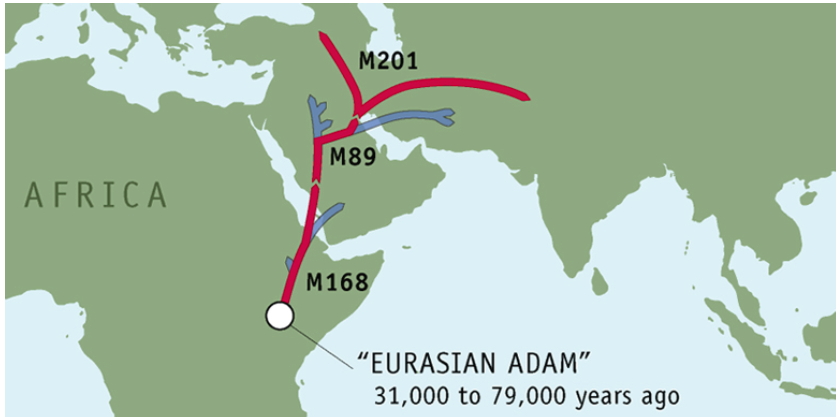
My Y-chromosome results identify me as a member of haplogroup G (M201).

The genetic markers that define my ancestral history reach back roughly 60,000 years to the first common marker of all non-African men, M168, and follow my lineage to present day, ending with M201, the defining marker of haplogroup G.
(What follows just below is interesting, but pretty technical...read at your own risk of falling asleep...scroll down to the maps if you're in a hurry).
In the Republic of Georgia (Caucasus Mountains south of Russia, north of Turkey) members of G make up as much as 30 percent of the population. Around 14 percent of the men on the island of Sardinia belong to this group, as well as ten percent of the men in north central Italy, eight percent of the men in northern Spain, almost seven percent of the men in Turkey, and lesser percentages in the Czech Republic, Slovakia, the Ukraine, Lebanon, Greece, Hungary, Albania, Croatia, and Ethiopia.
G is still represented in the Middle East-some of these are Arab, some are Jews, many are neither. Across northwestern Europe, only one to three percent of the men belong to haplogroup G.
Small numbers of haplogroup G can also be found in Syria (Arabs), Russia (Adygeans), Uzbekistan (Tartars and Karakalpaks), Mongolia, and western China (Uygurs). Members of haplotype G can also be found in Sicily, Hungary, Austria, Germany, France, Norway, and Sweden. Small numbers of men belonging to haplogroup G can also be found in China, Indonesia, Taiwan, the Philippines, and the Polynesian Islands of the Pacific.
 So I fired up Google Maps and created this map of the various places my ancestors were likely to frequent (click on map for larger version). The map actually agrees pretty well with more recent family history which puts my father's family in the Swiss/German geographic zone.
MY ANCESTRAL JOURNEY
 M168: My Earliest Ancestor
Time of Emergence: Roughly 50,000 years ago
Place of Origin: Africa
Climate: Temporary retreat of Ice Age; Africa moves from drought to warmer temperatures and moister conditions
Estimated Number of Homo sapiens: Approximately 10,000
Tools and Skills: Stone tools; earliest evidence of art and advanced conceptual skills
The man who gave rise to the first genetic marker in my lineage probably lived in northeast Africa in the region of the Rift Valley (see the orange balloon on the first map), perhaps in present-day Ethiopia, Kenya, or Tanzania, some 31,000 to 79,000 years ago. Scientists put the most likely date for when he lived at around 50,000 years ago.
His descendants became the only lineage to survive outside of Africa, making him the common ancestor of every non-African man living today.
M89: Moving Through the Middle East
Time of Emergence: 45,000 years ago
Place: Northern Africa or the Middle East
Climate: Middle East: Semi-arid grass plains
Estimated Number of Homo sapiens: Tens of thousands
Tools and Skills: Stone, ivory, wood tools
The next male ancestor in my ancestral lineage is the man who gave rise to M89, a marker found in 90 to 95 percent of all non-Africans. This man was born around 45,000 years ago in northern Africa or the Middle East. While many of the descendants of M89 remained in the Middle East, others continued to follow the great herds of buffalo, antelope, woolly mammoths, and other game through what is now modern-day Iran to the vast steppes of Central Asia.
My ancestors, having migrated north out of Africa into the Middle East, then traveled both east and west along this Central Asian superhighway. A smaller group continued moving north from the Middle East to Anatolia and the Balkans, trading familiar grasslands for forests and high country.
M201: Living in the Fertile Crescent
Time of Emergence: 30,000 years ago
Place of Origin: Middle East or Caucasus Mountains
Climate: Middle East: Semiarid grass plains
Estimated Number of Homo sapiens: Approximately 100,000
Tools and Skills: Stone, ivory, wood tools
My genetic trail continues with a marker that arose around 30,000 years ago, in a man born along the eastern edge of the Middle East, perhaps as far east as the Himalayan foothills in Pakistan or India. He has had relatively few descendants, and members of this clan are rarely present in population frequencies at greater than a few percent.
My ancestors were part of the Neolithic Revolution, the point at which humans changed from nomadic hunter-gatherers to settled agriculturists. Control over their food supply marks a major turning point for the human species: the beginning of civilization.
Instead of small clans of 30 to 50 people constantly moving to follow the seasons and the herds, they began to settle in much larger groups, occupying a single territory.
Larger settled communities spurred the need for trade, writing, and calendars, and pioneered the rise of modern sedentary communities and cities. The early farming successes spawned population booms and encouraged migration throughout much of the Mediterranean world.
My farming ancestors began moving out of the Middle East, through the islands and along the shores of the Mediterranean, through Turkey into the Balkans and the Caucasus Mountains.
It was once thought that the advancing farmers displaced or eliminated the hunter-gatherers of Europe. However DNA studies show that while the spread of agriculture did involve the movement of some people into Europe who had not been there before, for the most part farming was adopted by the existing Europeans. In other words, the culture, rather than the people, spread.
The whole report contains even more detail and I have to say it was well worth the $100 or so that it cost. You can get your own DNA tested and get a report on your ancestral journey at The Genographic Project.
Subscribe to:
Posts (Atom)