“Archaeology in the Oregon State Park System” is the title of the November 2, 2010 lecture sponsored by the Oregon Archaeological Society. From the Oregon coast to the Willamette Valley to John Day, Oregon’s state parks are the stewards of Oregon’s history, which is revealed in the cultural sites found within many of the parks. Nancy Nelson, Oregon State Parks and Recreation Department archaeologist, will provide
information on an array of archaeological site types found in state parks. Both precontact and historic archaeological sites will be highlighted, including Tseriadun, Fort Yamhill, and Kam Wah Chung.
Nelson received her education from Oregon State University and the University of Oregon in Anthropology. She has a broad range of experience working on archaeological and cultural resource projects in conjunction with the Coquille tribe; Confederated Tribes of the Coos, Lower Umpqua and Suislaw; the Yakima Nation; and the Ak-Chin Indian Community in Arizona.
The presentation is at Oregon Museum of Science and Industry (OMSI) at 7:45 PM, and is free and open to the public. The talk is preceded at 7 PM by a general business meeting, which is also open to the public
See www.oregonarchaeological.org or call 503-727-3507 for more information.
AIA Lecture: Friday, Nov. 12
November 12, 2010 - Friday 7:30 pm - School of Business Auditorium PSU
Susann Lusnia, Tulane University
“The Petrified City: Reading the Marble Plan of Rome”
Washougal Pedestrian/Petroglyph Tunnel Complete
...A Somewhat Tardy Report
 After months of work the Petroglyph tunnel in Washougal had its grand opening in mid-August. Well over 100 people came to the celebration (including several OAS members!) and were treated to speeches by Rep. Brian Baird, the current and a couple of former Washougal mayors, other dignitaries...and yours truly.
If you're near Washougal the tunnel is well worth a visit. You can find it by simply heading for the Pendleton Woolen Mills Outlet Store (also fun to visit), parking in their lot and looking south toward the river.
The City of Washougal deserves a lot of credit for building what will be a lasting addition to the community.

Three more of the seven panels in the tunnel.

Read more at: http://www.columbian.com/news/2010/jul/13/we-helped-guide-them-to-build-something-that-would/
See more photos and info at: http://culturewatchnorthwest.blogspot.com/2010/02/petroglyph-tunnel-entry-stone.html
Two Books to be Released Online
Two ground-breaking works on relations between Native Americans and early Pacific Northwest settlers will be released online this week by Oregon State University in celebration of the fourth annual International Open Access Week.
The OSU Press and the OSU Center for Digital Scholarship and Services are making available Theodore Stern¹s two-volume works, "Chiefs and Chief Traders: Indian Relations at Fort Nez Percés, 1818-1855," and "Chiefs and Change in the Oregon Country." First published by OSU Press in the 1990s,the books have been out of print for several years.
The books are free online as high-resolution, searchable PDF files in the press's collection in the ScholarsArchive@OSU open access repository: http://ir.library.oregonstate.edu/xmlui/handle/1957/18857
Raven Bluff: another dated Alaskan fluted point site
Northwest Coast Archaeology
qmackie | October 26, 2010
 "Some time ago I (Mackie) posted about the Serpentine Hot Springs site in Northwestern Alaska, at which several fluted points have been found, apparently dating to about 12,000 years ago. That’s about a thousand years more recent than Clovis, which is the best known of the early “fluted point” archaeological cultures from the Americas. I was interested to come across another site – Raven Bluff – which has recently come to light from the same general area, and which also has fluted points. At Raven Bluff, at least one of these dates to between about 12,000 and 12,500 years ago – also younger than Clovis, which is mainly confined to a narrow window around 13,000 years ago..."
Read the whole story at: http://goo.gl/nsw4
Rock Spirits at the Portals to Afterlife
By Andrew Howley
 A 14,000-year-old bone flute found inside Bédeilhac cave.
The final day of the 2010 IFRAO conference on Pleistocene Art of the World continued to present innovative approaches and fascinating discoveries about the well-known but little understood world of prehistoric rock art.
Tarascon-sur-Ariège, France--Anderzej Rozwadowski gave some enlightenment about the significance of rock itself to Siberian shaman culture, showing how parts of it may match up well with Paleolithic rock art traditions. Among some of these groups, when people die, they are seen as going to an afterlife that exists within the Earth's rock. Cracks and caves are then powerful places that can serve as passages between our world and theirs.
Rozwadowski also pointed out that often in Siberian rock art, images of a drummer (presumably a shaman) are paired with a wounded or hunted animal. If ethnographic evidence can identify this as a current symbol of human death, we may be one step closer to understanding similar images from elsewhere, including the famously mysterious scene of an aggressive wounded bison facing a human-like figure who could be falling backward, in a deep shaft at Lascaux...
Read the whole story at: http://goo.gl/tGqh
More at: http://goo.gl/eA5d
Vandals Strike N. Arizona Archaeological Site
By: Associated Press
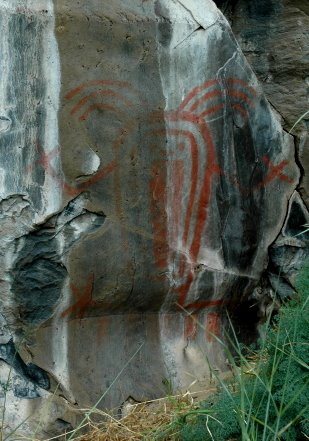
WILLIAMS, AZ - Archaeologists are assessing damage to a 1,000 year-old rock art panel in a northern Arizona forest.
A hiker reported the damage last month at the Kaibab National Forest's Keyhole Sink, named for the keyhole-shaped lava flow.
Read more at: http://www.abc15.com/dpp/news/region_northern_az/other/vandals-strike-n.-arizona-archaeological-site
Aged 9,000 Years, Ancient Beer Finally Hits Stores
by BRAD HORN
NPR
Dogfish Head brewery is known for making exotic beer with ingredients like crystallized ginger or water from Antarctica, so it might not sound surprising that one of its recent creations is a brew flavored simply by grapes and flowers. It's not the recipe that makes this beer so special; it's where that recipe was found: a Neolithic burial site in China...
Read the whole story at: http://goo.gl/dA9t
Subterranean Secrets-New Rock Art Discovery in Borneo Subterranean Secrets
 Photograph by Robbie Shone, Barcroft/Fame Pictures
Caver Andy Eavis compares his hand size with painted prints on the walls of the recently discovered Black Hands Cave, part of the massive Gunung Mulu cave system in the Malaysian section of the island of Borneo...
Read the whole story at: http://goo.gl/QSoP
(Thanks to Oregon Heritage News, Northwest Coast Archaeology Blog, National Geographic, AIA, and Robin Harrower, Pat Lyttle, and Jodi Lorimer for some of the info in this message.)
Copyright (C) 2010 CultureWatch Northwest All rights reserved. Previously copyrighted material is the property of the copyright holder.