Finally!! The results from my Genographic Project DNA test have arrived...and Lexie is mad that HER genetic history is missing.
Too bad, so sad...MY report is fascinating.
Below I've included some of the most interesting bits of information about my ancestral journey.
I've borrowed freely from the report that the Genographic Project sent me (and fully acknowledge any copyrights they may claim...but, hey, I paid for it).
MY GENETIC HISTORY
My Y-chromosome results identify me as a member of haplogroup G (M201).

The genetic markers that define my ancestral history reach back roughly 60,000 years to the first common marker of all non-African men, M168, and follow my lineage to present day, ending with M201, the defining marker of haplogroup G.
(What follows just below is interesting, but pretty technical...read at your own risk of falling asleep...scroll down to the maps if you're in a hurry).
In the Republic of Georgia (Caucasus Mountains south of Russia, north of Turkey) members of G make up as much as 30 percent of the population. Around 14 percent of the men on the island of Sardinia belong to this group, as well as ten percent of the men in north central Italy, eight percent of the men in northern Spain, almost seven percent of the men in Turkey, and lesser percentages in the Czech Republic, Slovakia, the Ukraine, Lebanon, Greece, Hungary, Albania, Croatia, and Ethiopia.
G is still represented in the Middle East-some of these are Arab, some are Jews, many are neither. Across northwestern Europe, only one to three percent of the men belong to haplogroup G.
Small numbers of haplogroup G can also be found in Syria (Arabs), Russia (Adygeans), Uzbekistan (Tartars and Karakalpaks), Mongolia, and western China (Uygurs). Members of haplotype G can also be found in Sicily, Hungary, Austria, Germany, France, Norway, and Sweden. Small numbers of men belonging to haplogroup G can also be found in China, Indonesia, Taiwan, the Philippines, and the Polynesian Islands of the Pacific.
 So I fired up Google Maps and created this map of the various places my ancestors were likely to frequent (click on map for larger version). The map actually agrees pretty well with more recent family history which puts my father's family in the Swiss/German geographic zone.
MY ANCESTRAL JOURNEY
 M168: My Earliest Ancestor
Time of Emergence: Roughly 50,000 years ago
Place of Origin: Africa
Climate: Temporary retreat of Ice Age; Africa moves from drought to warmer temperatures and moister conditions
Estimated Number of Homo sapiens: Approximately 10,000
Tools and Skills: Stone tools; earliest evidence of art and advanced conceptual skills
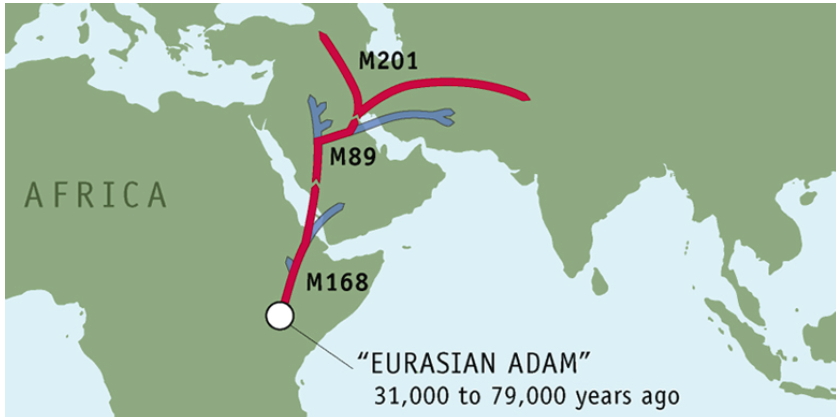
The man who gave rise to the first genetic marker in my lineage probably lived in northeast Africa in the region of the Rift Valley (see the orange balloon on the first map), perhaps in present-day Ethiopia, Kenya, or Tanzania, some 31,000 to 79,000 years ago. Scientists put the most likely date for when he lived at around 50,000 years ago.
His descendants became the only lineage to survive outside of Africa, making him the common ancestor of every non-African man living today.
M89: Moving Through the Middle East
Time of Emergence: 45,000 years ago
Place: Northern Africa or the Middle East
Climate: Middle East: Semi-arid grass plains
Estimated Number of Homo sapiens: Tens of thousands
Tools and Skills: Stone, ivory, wood tools
The next male ancestor in my ancestral lineage is the man who gave rise to M89, a marker found in 90 to 95 percent of all non-Africans. This man was born around 45,000 years ago in northern Africa or the Middle East. While many of the descendants of M89 remained in the Middle East, others continued to follow the great herds of buffalo, antelope, woolly mammoths, and other game through what is now modern-day Iran to the vast steppes of Central Asia.
My ancestors, having migrated north out of Africa into the Middle East, then traveled both east and west along this Central Asian superhighway. A smaller group continued moving north from the Middle East to Anatolia and the Balkans, trading familiar grasslands for forests and high country.
M201: Living in the Fertile Crescent
Time of Emergence: 30,000 years ago
Place of Origin: Middle East or Caucasus Mountains
Climate: Middle East: Semiarid grass plains
Estimated Number of Homo sapiens: Approximately 100,000
Tools and Skills: Stone, ivory, wood tools
My genetic trail continues with a marker that arose around 30,000 years ago, in a man born along the eastern edge of the Middle East, perhaps as far east as the Himalayan foothills in Pakistan or India. He has had relatively few descendants, and members of this clan are rarely present in population frequencies at greater than a few percent.
My ancestors were part of the Neolithic Revolution, the point at which humans changed from nomadic hunter-gatherers to settled agriculturists. Control over their food supply marks a major turning point for the human species: the beginning of civilization.
Instead of small clans of 30 to 50 people constantly moving to follow the seasons and the herds, they began to settle in much larger groups, occupying a single territory.
Larger settled communities spurred the need for trade, writing, and calendars, and pioneered the rise of modern sedentary communities and cities. The early farming successes spawned population booms and encouraged migration throughout much of the Mediterranean world.
My farming ancestors began moving out of the Middle East, through the islands and along the shores of the Mediterranean, through Turkey into the Balkans and the Caucasus Mountains.
It was once thought that the advancing farmers displaced or eliminated the hunter-gatherers of Europe. However DNA studies show that while the spread of agriculture did involve the movement of some people into Europe who had not been there before, for the most part farming was adopted by the existing Europeans. In other words, the culture, rather than the people, spread.
The whole report contains even more detail and I have to say it was well worth the $100 or so that it cost. You can get your own DNA tested and get a report on your ancestral journey at The Genographic Project.