Upriver of Vancouver, Washington the Columbia River bank is edged with thousands of rounded basalt boulders.
Ripped from the up-river bedrock thousands of years ago by massive ice-age floods these rocks, once part of the volcanic landscape, were shaped as they rolled downstream in massive torrents of water.
Over a hundred floods, that for a time carried more water than
all the other rivers on earth combined, gouged the earth to form what is now called the Columbia River Gorge. The boulders are all that remain of over 50 cubic miles of dirt and rock that were violently flushed into the Pacific.
 Rounded boulders shaped by the Missoula Floods.
In the Vancouver area alone, over a hundred of these boulders hold ancient Indian rock art. The most common marks left by the prehistoric people are

cupules...thousands and thousands of cupules.
Some individual rocks hold several hundred of these distinctive marks...small (1"-4" across) cup-shaped indentations in the rock that are formed by pounding a hand-held "hammer stone" repetitively against the surface of the boulder.

Why make a cupule? Why do some rocks hold only a single cupule but others have hundreds of these mysterious dimples?
Theories abound...but two seem to hold the most promise.
One, the "Baby Rock" theory holds that ancient women sought the rock powder that was produced as the cupule was formed. The powder was believed to hold spiritual power that, when eaten or rubbed on the body, would help a woman become pregnant. There is significant evidence from similar sites in Northern California to support this idea.

But was it the same along the Columbia?
A second theory proposes that the cupules were formed by Salmon shaman. These shamans were important spiritual leaders whose role it was to call the schools of Salmon back from the ocean every year so that the people could eat, live, and prosper. The Salmon were thought to hear the shaman pounding on the rock and return to where they could be caught to nourish the tribe.
In either case, the point was not the cupule itself...cupules were simply by-products of another important activity.
Both ideas are intriguing...but do they reflect reality? Trying to look into the minds of ancient people is fascinating. Physical evidence can be studied, ethnography can be mined, present day descendants can be interviewed and, of course, opinions abound...but to a significant extent the mystery remains...who were the ancient people of the Columbia, what were their beliefs, and what are the true meanings of the art and the symbols they left behind?
Of course, partial answers can be found to all of these questions, but the true richness of a prehistoric culture can never be fully experienced...and that's a big part of what makes it so appealing.
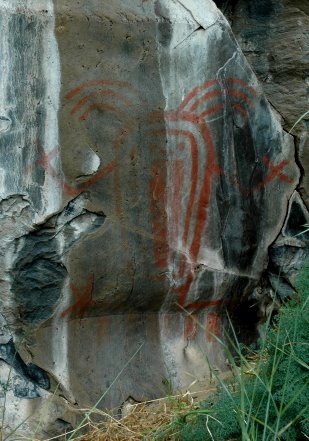
 Temanawas Rock overlooks the Columbia River near Vancouver, WA
As interesting as they are, cupules aren't the only rock art along the lower Columbia River. Stay tuned and we'll continue to explore!

 Mystery, intrigue, petroglyphs, the Columbia River Gorge...what else could anyone interested in archaeology and fiction ask for?